Will the nature of the audience change the way musicians play? For whom does one play?

13239233_10208052524984311_2729591926319692137_n

Being a musician and an avid visitor of classical music concerts, I would like to think about the questions: will the nature of the audience change the way musicians play and.. for whom does one actually play?
There is a story about a famous piano virtuoso and composer Franz Liszt who was criticized by playing Bach in public. Liszt was a brilliant performer and his answer to this was three different Bach performances: one as the composer would have played it in public, then more personally, as he played it for himself, and finally, as an imposter for a grand public – all this while smoking a cigar with great enjoyment (Charles Rosen, “Piano Notes: the hidden world of the pianist”) It is clear from this story that Franz Liszt had several performance styles and could interpret the piece differently. The second time I thought about different performance styles of the same work was through an interview of Yuja Wang when she said that she did not want to repeat herself by playing so many concerts with the same program. She wanted to remain creative and motivate herself through discovering new aspects of her music. Yesterday was the third time that brought me back to the topic of different interpretation of the same piece for different audiences when one lady from the audience thanked me for playing George Gershwin “The man I love” “differently than my YouTube video” where she heard it for the first time and found it sounding “more dynamic”. I was surprised as I did not change anything about my interpretation but as it was a private event with a certain motto; I just wanted to play the piece as if the salon lady would have played it herself. Apparently, a small change in the direction of the communication helped me to hear this piece differently too.
Will the nature of the audience change the way musicians play? This question fascinates me, especially as these days the musicians take over the marketing concepts into their work. The idea of public performance of music compositions was born in the 19th century. It is difficult to imagine but Beethoven sonatas were not performed for large audiences during his life. The 18th century music making always had the music performance within the social context – just think of the “Tafelmusik” played in the court of noblemen, for example. Franz Liszt introduced an idea of solo recital for bigger audiences. As there were more and more people willing to listen to the music for the music sake, the public performance has become a standard medium for presenting a work of music. In a way, it is still the only aesthetic criteria for many musicians who strive to be performing artists. Public playing in a concert hall takes the music compositions out of the context, it makes them even more abstract and turns into an object that can and should be judged. It was a beginning of the music journalist and music criticism. In a concert hall there is a clear division of roles with a performing artist who has a name and a personality and an anonymous audience. In the salons, for example, the guests know each other and there is a conversation with the artist before or after playing. Today, If the lights are dimmed in the concert hall, a musician cannot even see the people in the audience or recognize faces. Unlike the singer or the violinist, the pianist does not even face the listeners while playing. Does it mean that the musician is not even aware of the audience during actual playing? It sounds like a paradox but I would have less stage anxiety in bigger rooms and where there is a physical distance between the stage and the audience. Introducing the music to the audience before starting playing a group of pieces reduces the formality of the event but it is an awesome experience too as you can feel the difference between playing and talking. During talking, you face the listeners, see their facial expressions and get an immediate reaction. Our brain registers the visual feedback within milliseconds! During the actual playing, the only way of getting the audience reaction is to listen to the sounds the audience is making. It can be shuffling, coughing, breathing, but the quieter it gets, the more mysterious the atmosphere gets. The degrees of silence gives an orientation for the audience attention. Charles Rosen has a very clear view on coughing that he considers a sign of inattention and not a sign of low winter temperatures.
The musical performance is all about the non-verbal communication that leads me to my next question: for whom does the artist play? Does he or she play for everybody or for nobody, perhaps for oneself? There is a ready answer that the artist plays for music but it brings even more questions with it. If the artist plays for music, then playing alone in a room would be enough? A direct undisturbed dialogue with the music? Anna Netrebko said in her interview once that anybody who experienced being on stage even once, would want to come back, it is like a drug that brings the artists back onstage – just thinking of an 82 year old Horowitz who would go back to public recitals from 1985 to 1987 after a break of 16 years. In pop music culture, we have the whole bunch of old generation musicians like Eric Clapton, Rod Steward and Paul McCartney who venture out new concert tours again and again.
American pianist Julius Katchen had his method – he would single out one person in the audience when he came first on the stage and he would send out his playing to this person. It is a known psychological trick – usually there is always at least one positive person in the audience who would smile back, nod back and show in an open and friendly way that he or she is really enjoying your performance. It is a question about the energy and if the audience is sitting with reserved attitude, the musician is going to feel it too.
I think the trend is come back of the Biedermeier times and a certain longing for retreat into a private world of simple pleasures and individual music experiences. I use the term “Biedermeier” to refer to more safety, staying at home and enjoying the home, finding more attractions in one own country. There is an increasing number of private and semiprivate musical events. The culture of salon is experiencing revival too. In home music making is getting more and more popular. As the classical music market is oversaturated, there are more and more professionally trained musicians who are not able to earn money through public performances. The so-called music amateurs with a high degree of musicianship blur the borders between the commercial and non-commercial music making. The locations for public concerts are getting more creative too. Imagine an Internet page where you can book a ticket for your favourite musician playing Beethoven in a flat xy just a couple of meters away from your domicile? (It is a reality in USA http://www.concertsinyourhome.com/ ) The idea of the public concerts “at home” was born out of the conflict of interest. On the one hand, you have an audience – people who are paying money and dedicating their free time to one person who is providing “musical services”. The audience wants to get inspiration and have a quality time. On the other hand, you have the artist who is doing the job and who is under pressure to perform. The abstract music needs the context, sometimes the occasion helps too. Friendly atmosphere can make Mozart piece sound up-to-date and take away the paleontological feeling that some might get in a traditional concert. The spur of the moment feeling and the degree of improvisation can bring back the freshness of otherwise only “historical” interpretation. The imperfect performance is allowed and the beauty of individual interpretation can blossom!
What are your thoughts? Will the nature of the audience change the way musicians play? For whom does one play? Thank you for sharing your thoughts and an interesting discussion!

Country:

Posted in Uncategorized and tagged , , ,

How native language can influence musical compositions and if we need the knowledge about the language, e.g. German, in order to understand Mozart or Haydn?

666A0674

There is a saying as old as the world that the music is a universal language. Is it true? The diversity is the name of the game. The composers had different cultural backgrounds and spoke different languages. Did their mother tongue influence their compositions and do we need the knowledge about the language, e.g. German, in order to understand Mozart or Haydn?
Foreign languages have always fascinated me. Each of them has its own rhythm, melody, intonation… It gets even more exciting when it comes to the specific words that we understand only in the context of the culture where this language is being spoken. Like my favorite English phrase: “It’s raining cats and dogs”. And each language has something unique! English – being a language of business and travel, but also an “old English” being a language of Shakespeare. German – so concise and precise at the same time, with complex grammar and particular rhythm of the sentence. French – a bit vague and therefore, perfect match for the diplomatic talks, with exquisite melody. Italian – passionate language of love – very musical! For me, as a native Russian speaker, the Spanish would sound incredibly fast. I heard a remark about the Russian pronunciation that it is a bit harsh and not very smooth for English native speakers due to the falling intonation and consonants. I made an interesting experience when I was talking about the music in front of the international audience and they wanted me to introduce the pieces in Russian, German and English. The reaction of the audience surprised me. Despite the fact that it was the identical information, they were saying, it was as if I would have three voices and three personalities.
On that day, I was playing an international piano program where Mozart would follow my Debussy and Rachmaninoff went along with Beethoven. When playing through Beethoven Sonata, I suddenly remembered me speaking German and I thought that the Beethoven music phrases are like German language, the same pattern, and the same grammar structure! I had the same difficulties at the piano as five minutes before during my presentation.
Talking to the audience after the concerts, I noticed that in general, the German audience has problems with Tchaikovsky or Rachmaninov, let alone Skryabin. They find the music a bit “befremdlich” – disconcerting and outlandish. The other way round, I get suggestions to work harder on my Mozart and Beethoven, as they should be played “differently”.
Let me explain it in more detail through the popular communication model. It is an approximation of a real-life situation. There is a sender and a receiver for the communication to take place. I have three variables: a musician (a sender), composer (initial impulse) and audience (a receiver). I chose the Russian nationality due to my background, the word “Russian” can be any nationality.
There are four options.

Option 1. Russian musician is playing Russian music to Russian Audience.

Option 2. Russian musician is playing Non-Russian music to Russian Audience.

Option 3. Russian musician is playing Russian music to Non-Russian Audience.

Option 4. Russian musician is playing Non-Russian music to Non-Russian Audience.

Option 1. Russian musician is playing Russian music to Russian Audience
We hear and receive music through the filter of social and cultural context. Russian audience were exposed to Russian composers in schools and through media. They grew up with these melodies. As music takes roots in the folklore and folk songs, even in case of Skryabin who is considered “Pro-European” in Russia, you hear the Russian language melody in music composed by Russians. Russian audience would know what kind of person the composer was. I find that the psychological portrait of a composer or at least a slight idea about it might help us to approach their music. The audience could imagine what theaters the composers were visiting, what food or drinks they were enjoying, how society and political system influenced the composers, what the weather was like. istorical events in the home country are more familiar from school. All in all, the exposure to native composers is the highest in their motherland. In my model, I would presume that the performer has inhaled this music from an early age. I guess the both a musician and the audience speak the same language.
Option 2. Russian musician is playing Non-Russian music to Russian Audience.
When a Russian musician ventures out to present Non-Russian music to Russian audience, receivers might have no idea about the cultural environment of the music they are listening to. When audience is open and curious, this program will be a real cultural journey. In case of more conservative audience, creating the context would help to make the program more appealing to local audiences. The program notes, introductory talk about the composers and their background, some dia show, video installations might be a way of preparing the audience for more enjoyable listening.
Option 3. Russian musician playing Russian music to Non-Russian audience.
It goes without saying that the musician might not sell many tickets in the first place, but if people come to listen, they are true fans of the program and the Russian musician with Russian repertoire is a star! Authenticity wins! It makes me think of Denis Matsuev solo concerts in Munich! He played Mussorgsky “Pictures of Exhibition” and rocked the boat, although there were many free seats. Today, when we have a free access to the recordings of e.g. Skryabin played by pianists of different nationalities, I would still take time to listen to Russian old masters like Heinrich Neuhaus or Vladimir Sofronitsky.
Option 4. Russian musician is playing Non-Russian music to Non-Russian Audience
The fourth option is the most frequent case in big concert halls nowadays. The feeling of playing Ravel for French, Beethoven for Germans for any musician who is coming from a different culture is awesome. Every country has the so-called traditions or even schools based on these traditions how to play their own national music. They are rock-solid in the minds of the audience. Like a foreigner speaking the language with a charming accent, international musicians bring creativity and freshness into the “national” repertoire. Any fresh ideas can make performance very interesting. Different phrasing, new accents, and perhaps even a complete new vision of the piece will help to make the “museum” Mozart sound very modern. Just thinking of Fazil Say and his interpretation of Mozart Sonatas. Diversity keeps the classical music alive.
What is your experience with listening and playing music of composers from your native country and other countries? Do you feel the connection with the language? Do you feel the difference? Thank you for sharing your thoughts with me.

Country:

Posted in Uncategorized and tagged , , ,

Blog about inspirational power of hobbies

Coast

One day after having conducted a music-based training „Creativity Break 45“ in one multinational corporation, I was approached by an engineer who wanted to have a piece of advice. His dilemma was exactly what I witnessed in several companies. He is successful in his job, the job is secure, but it is unlikely that he would move to a next career step. He is 48, has teenager kids and has no financial problems, but there is something in his life that he thinks he is missing. He thought of moving to another town with another company, but decided against it at the end. So he is stuck in his comfortable position. What to do? Was his question. The first intuitive thought that came to my mind was a question back: Do you have a hobby that might give you an inspiration?
I remember once having read an interesting thought by Carl Jung who put into words exactly the situation this man was going through. He wrote of the psychological development that when we approach the middle of life, we have achieved a lot: had children, have gained some money, perhaps gained social status or even modest recognition in our field of activities. We have gained the confidence but there is a price for it. Carl Jung writes that at the same time “we overlook the essential fact that the social goal is attained only at the cost of a diminution of the personality”. It is possible that “many aspects of life which should have been experienced lie in the lumber-room among dusty memories”. “Moneymaking, social existence, family and posterity are nothing but plain nature – not culture. Culture lies beyond the purpose of nature. Could by any chance culture be the meaning and purpose of the second half of life?”
Some psychologists speak about the creative DNA that is hidden in all of us. As children, we started our life journey through creativity. We discovered the world gradually through the creative activities. Everything that we experienced was new and appeared as if from nowhere. Just take one minute of your time and do a little experiment with me: try to remember what your first creative act was. Did you draw? Or was it something you did with your hand with clay? Or perhaps dancing or singing? We all went through the process of creation to the moment where there were first obstacles for the achievement of creative idea and unless our talents were recognized early and pushed, we would have decided to work in the field of creativity professionally. But it does not mean that we are not creative.
Every job has periods of routine, and the mastery leads to the state where we do not think about what we are doing and replace the active thinking by routine processing. It is also part of the efficiency and it means that we can save the energy for other activities. In worst case, we do not make use of this extra energy. It was a big surprise for me to read a book by Arnold Bennett “How to live on 24 hours a day”. This book appeared in 1910 (!) and the idea of the book was to show why the employees are invariably “haunted by a suppressed dissatisfaction”. He says that this “springs from a fixed idea that we ought to do something in addition to those things which we are loyally and morally obliged to do”. His solution is to have a hobby. He believes that the period spent with one’s hobby or passion “will quicken the whole life of the week, add zest to it, and increase the interest which you feel in even the most banal occupations”.
Imagine my excitement when I read the book “Creativity, Inc” by Edwin Catmull, president of Pixar Animation and Disney Animation, where he writes about the importance of offering the employees during the working hours the classes of “sculpting, painting, acting, meditation, belly dancing, live-action filmmaking, computer programming, design and color theory, ballet…” you name it. Surely, the class material does not directly enhance the employees’ job performance. It is a more a case of experiencing the creativity process that is valuable for any business activities like learning by doing, improvisation, testing our patience, experiencing the missteps and imperfections. Fun is also an important aspect of these classes. This way it puts employees into good spirits. The good mood does wonder at workplace!
Not every company or organisation offers these possibilities. We do not have to wait for our company to draw our attention to the wonderful opportunities. We could listen to ourselves and start a discovery journey full of curiosity, interest, passion and beauty. There is a new world of creativity that will open to us when we do things we never have done before: like going to classical concerts we considered boring, visiting museums that we ignored, starting a conversation with the creative people whom we thought so different from us and “strange”.

So ask yourself - what is your ideal creative activity – it does not matter how difficult it may sound. All you need to do is just start. If you are still not persuaded, I suggest you read the book “Play it again„ by Alan Rusbridger, Editor in Chief of the Guardian, who managed to re-start his piano playing in his 50s despite very full work schedule!

Country:

Posted in Uncategorized and tagged , ,

Robert Adams from http://mramusicplace.net explores the devices composers use to control the speed of their music.

recite-vgbylk

It seems simple enough; when music gets faster, we call it an accelerando. Orchestral musicians know they have to watch the conductor, and conductors know they have to give an increasingly faster beat to create the accelerando. As far as it goes, this is all correct. But is increasing the beat the only way composers and performers create increases in speed?Are tempo and speed the same?

Consider the beginning of the final movement of Dvorak’s symphony no. 9, “From the New World.”The tempo is constant throughout, but the speed of the music clearly increases. This increase is achieved entirely through rhythmic means. The motif of an ascending semi-tone (half step) is written with a longer duration on the first note of the interval, and is followed initially by two beats of rest, thereby spacing out the second occurrence from the first. After one repetition, the duration of the first note is reduced by half a beat, and the rest between occurrences is also reduced, from two beats to just half of one beat. By the fourth measure, the first note of the interval is down to only half a beat, and the rest in between is down to one-quarter of a beat. In each case, the unit of the beat is the quarter note. By composing the rhythms this way, Dvorak has written an accelerando without increasing the tempo; therefore, accelerando and increase in tempo are not synonymous.

Apart from changes in speed, rhythm is also frequently used to present the same melodic material at the same tempo but at different speeds. Brahms was particularly fond of doing this. For example, in the fourth movement of the A Major Piano Quartet.27, measure 467, the accented material that is heard throughout the movement is played in the violin and viola in its original form, while in the piano, the pianist’s left hand plays it half as fast due to elongation, but at the same tempo.

From these examples, we can see that relying on tempo to define how fast or slow a piece of music goes is insufficient. Music with an extremely slow tempo may go quite quickly, as with the fast moving string parts playing sixteenth notes that accompany the slow moving theme written mainly in whole note and half notes in alla breve in the final section of Wagner’s Prelude to Tannhauser. To accurately define the speed of music, we must consider both tempo and rhythm. Music that is perceived as fast has notes that move at a relatively high rate per second, regardless of how they are notated. This can be achieve with a combination of a fast tempo and note duration equal to or divisions of the beat, or with a slow tempo and note durations that are further divisions of the beat. Conversely, music that is perceived as slow can be achieved with a combination of a slow tempo and note durations equal to or elongations of the beat, or with a fast tempo and note durations that are further elongations of the beat

In either of these cases, a rhythmic hierarchy is likely to be established. Music written primarily with divisions of the beat is likely to be perceived with a beat unit of a longer duration in order to keep the tempo manageably slow, while music that is written primarily with elongations of the beat is likely to be perceived with a beat unit of shorter durations, what musicians call subdivisions, in order to keep the tempo manageably fast, because both excessively fast and excessively slow tempos are difficult to comprehend and cognitively maintain. This is why designating a unit of beat is so important. It makes a tremendous difference if the beat is equal to a half note or a quarter note or an eighth note. The difference from one to the other in each case is halving the tempo.

From the listener’s perspective, the tempo at which music is moving is going to depend to Picture1a large degree on what beat unit he or she perceives, while we could expect the speed of the music, because it is measured in time and not beats, will be more reliable and consistent from on listener to another. An example of this is the first movement of Beethoven’s fifth symphony. A person (or conductor) who perceives the beat in quarter notes is going to find the music has a fast tempo; it has both a fast (quarter note) beat, and mostly durations that are divisions of that already fast tempo beat. A listener (or conductor) who perceives the beat in half notes is going to find the music has a moderate tempo and a fast speed; it has a moderate (half note) tempo, and mostly durations that are further divisions of that beat. The speed is still fast because the notes are moving at the same rate per second, and are divisions of divisions of the half note beat.While rare in practice, it is even possible to perceive the music with a whole note beat, giving the music a slow tempo but still fast speed. Listening to, conducting, or performing music with a slow tempo beat is valuable because it reveals rhythmic structure at a deeper level, focusing our perceived organization of the music over longer time spans compared to zeroing in on beats that occur over shorter time spans of music. For musicians, it is useful to be flexible in this matter so that listening comprehension is enhanced, and difficulties adjusting to conductors who use a different tempo beat than the musician is used to are minimized.

I mentioned earlier that tempo is measured in beats, while speed is measured in time. This statement needs some tightening up, because tempo itself is a kind of speed, and tempo is typically defined in units of beats per minute, as revealed in tempo markings and metronome usage. The distinction between beat and speed is necessary, as we have seen, because they can go in opposite directions. Even so, ultimately both are defined by time. This being so, the speed at which music moves must be defined entirely by time, and specifically by the number of musical events, whether they are beats, elongations of the beat, or divisions of the beat, that occur per unit of time. It is useful to define beats in units of occurrences per minute, because that is the established convention, and because beats are slow enough, even at fast tempos, to be so defined. Divisions of the beat, on the other hand, are more conveniently defined in units of occurrences per second. This is useful because knowing only the tempo does not give an accurate description of the speed.

Country:USA

Posted in Piano and tagged , , , ,

Can music scare? Why some dissonant sound combinations frighten? Have you experienced the music compositions that would make us scared? How did you feel? Thank you for sharing your views! Looking forward to hearing your opinion and feedback!

800px-Edvard_Munch_-_The_Scream_-_Google_Art_Project

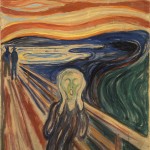
Music is all about emotions. Composers know how to evoke emotions through their intuition. However, emotions range from the positive feeling of happiness to fear and panic on the negative scale. Music can scare! The frightening effect of music brings the feeling of suspense and enriches our emotional experiences. The best example is the use of music in film industry, the famous shower scene in a Hitchcock thriller “Psycho”. Listening to this video scares. You can try it with and without sound. The impact is big! We hear much dissonance. But why do these simple musical tones have such a scaring effect on listeners?
Scientists came up with a conclusion: dissonant harsh sounds can invoke a deeply ingrained instinctive response. There is a connection between the suspense music and the screeches of frightened baby animals in distress. The Amygdala – almond-shaped structure in our brain is responsible for figuring out where we should be afraid of something. If the answer is yes, it fires all signals getting the body ready to run or fight. It is a natural biological reaction.
Daniel Blumstein is a leading scientist on this study and he is an expert on animal distress calls. He analyzed the link between screeches of different animals and soundtracks from movies. He also found that when the melodies suddenly became higher, there was greater emotional stimulations than in the moments when the notes went lower. It is also connected to the fact that when we are frightened, our voices get higher due to more tension in the vocal cords. Apparently, visual stimuli dominate the audio stimuli, so the effect would not work if we pair the harsh dissonant music with pictures of fluffy teddy bears.
It is interesting that music theorists in the Middle Ages suggested to composers to avoid certain combinations of notes like the triton (two notes with three whole steps apart like F and B) so as not evoke negative emotions. This triton was even called devil in music (Diabolus in musica).
Researchers also agree that the music mostly becomes emotionally colored through context and associations. It makes me think of Requiem and Dies Ira (Day of Wrath) – the lyrics of the catholic mass remind us of the terrible Judgement day and composers like Mozart and Verdi knew how to make this movement sound really strong and frightening. There are examples by Modest Mussorgsky “Songs and Dances of Death”, Danse Macabre by Camille Saint-Sans, “Dance of Death” by Franz Liszt – there was a macabre fascination by fear of hell. In contrast, the music of Johann Sebastian Bach „Toccata and Fugue in D-minor,” did not sound scary until it was used in movie like “Dr. Jekyll and Mr. Hyde”.
Some music techniques like speeding up or growing louder could help our imagination to feel the danger or hint that a character is being chased. The use of dissonant tones, the jerky sounds that come and go abruptly, much percussion, high-pitch disturbing sounds bring the feeling of fear into the music. Changing dynamics and the deliberately chaotic structure of the piece can send the chills down our spine. The rhythm is very important – it is associated with the footsteps, ticking clock, heartbeat, breathing you name it! Hearing unfamiliar strange sounds can also sound very weird. So many composers use unusual instruments or play instruments in unusual ways. It makes me think of John Cage or George Crumb and their compositions for prepared piano.
These days we have sound designers whose job would be to create new sound combinations to serve the purpose.
Have you experienced the music compositions that would make us scared? How did you feel? Thank you for sharing your views! Looking forward to hearing your opinion and feedback!
Von Edvard Munch - Google Art Project: pic, Gemeinfrei, https://commons.wikimedia.org/w/index.php?curid=37624942

Country:

Posted in Uncategorized and tagged , , ,

Blog about the silence, fresh air, leisure activities and why they are so important

20160403_140646

Last weekend I spent hiking in the mountains and enjoying the fresh air. The weather was sunny and beautiful and there were many people outside. They were hiking, riding bicycles, motorcycling, climbing the mountains, paragliding, fishing, riding cars for fun, jogging, picnicking…People were enjoying their leisure time.
‘We work,” Aristotle wrote, ”in order to have leisure.” Today, this is still true. There have always been breaks from the routine of work-taboo days, market days, public festivals, holy days-we could not survive without them. Leisure has historically been the privilege of the rich. Opportunities for leisure came with more income and less working hours. I noticed this change in Russia when at the turn of the century people started doing more outdoor activities and developed interesting hobbies.
We all need a break from our daily work, household chores and the routine. The recreational activities can work wonder! Scientists discovered that walking in nature causes brain growth in hippocampus region resulting in better memory. Evolutionists explain that a walk in nature sparks our spacial memory exactly the way it did when our ancestors went hunting! It gives our brain uninterrupted focus and helps memory consolidation.
Walking in nature has even more advantages! It brings back the silence in our lives! Being a musician, I realized how important silence is. We are constantly surrounded by various sounds and noise. Just think of air conditioning or refrigerator. When you are a musician, you are exposed to thousands of different sounds depending on instruments; some might be even very loud. We are listening to music, analyzing music, making music ourselves. Our ears are overflown by the acoustical information. Apparently shutting off the faculty of speech heightens the sensitivity. So we are regaining the quality of being sensitive to the sounds, which is of paramount importance for any musician! Through silence, our focus is being shifted to our thoughts, emotions, and sensations. Psychologists could prove that our empathy has limits and needs to get a fresh start too. If we are burdened by the daily problems, we lose the ability to perceive, interpret and process emotions, be it our own or somebody else’s. It gives us an explanation why many composers took long walks and searched for solitude and silence. It makes me think of Beethoven – a restless walker who would hike for hours just to end the day with a great idea of a new sonata. Nature retreats can be very inspirational: psychologist Kelly McGonigal says that during hiking we are able to cultivate a form of mindful intention. If we couple it with the refreshing effect, we can easily see why we are back to work full of energy and are fully motivated to take action.
Free time activities are the best creativity training we can get! Free time moments are perfect for incubation time and absorption time any new material or information needs. There is life outside of music! It is up to us to make the best out of it!

Country:

Posted in Uncategorized and tagged , , , ,

Blog about classical music and fashion, Mozart love of luxury, what the stars of classical music wear on stage, embodied cognition and most importantly: Will Beethoven sound differently depending on the attire of the musician?

Shakespeare once said, “Clothes make the man”. Nobody will deny that styling can play a decisive role in the image of a classical musician. We are so used to the excessive PR campaigns and the pop culture stars like Madonna, Lady Gaga and Beyoncé who set the benchmark in the world of image making. Today we are speaking about a new image of classical musicians. Especially when they are searching for new ways in classical music.
When we think about musicians in philharmonic orchestras, we immediately see people wearing black. It could be black tuxedoes with tails and white ties for highly formal event like a gala or opening night of a new season, or just black suit jacket with monochrome necktie. There is a convention that musicians should wear the “concert black”: the specifics (jacket/no jacket/tie or no tie/vest or without) are less important as long as it is black. The tradition comes from Mozart days when musicians wore the uniform of the court they were paid by. Tailcoats became a substitute “uniform”. In other words, the “concert black” is the musicians uniform. Even back in those days, the soloists were permitted to wear just about anything: The most popular performers wore the best clothing they could get for their performances. Mozart himself had a penchant for luxurious clothing. As is evident from his letters and contemporaries, extravagant dress was Mozart’s preference, but it was also necessary as a vehicle of his artistry in Viennese society. In a letter to his father on September 5, 1781, Mozart writes, “I could not go about Vienna like a tramp. One must not make oneself cheap here - that is the cardinal point - or else one is done.” Here is a description by Irish tenor Michael Kelly who wrote in his memoirs, Reminiscences: “I remember that at the first rehearsal of the full band Mozart was on the stage, with his crimson pelisse and his gold-banded cocked hat, giving the time of the music to the orchestra”.
Psychologists noticed the frequency with which many musicians show a vivid interest in fashion. For many musicians the fashion and interest in luxury is an extension of their creativity and attempt to invent and re-invent themselves. Musicians are being trained to excel, so they transfer it to other areas of creativity. This search can be extended to even further field of searching for beauty in every aspects of their lives.
Today it is difficult to tell if it is a musician who decides what to wear onstage or if it is a decision of the artist’s management. Here are some interesting facts: 21-year-old Canadian pianist Jan Lisicki wears classical black jackets but he loves the splash of color for his socks. Nicolai Tokarev is often seen onstage wearing the tight leather pants and designer long-sleeved T Shirts. Daniil Trifonov is playing with a business-looking suit, white shirt and a fancy colored tie. Star violinist Joshua Bell looks very casual on stage without a jacket. Christoph Eschenbach frequently wears a Nehru jacket when he conducts. Violinist Hahn-Bin favors a flamboyant look, really extravagant. But the most unconventional is definitely an English pianist James Rhodes: he shuffles around the stage in sparkly shoes, skinny jeans and oversized glasses, shoulder-length hair.
The women have more freedom when choosing their attire. Pianist Olga Scheps has a “natural look”, Helene Grimaud seems to not to think too much about what she is wearing. One musician remembers her carrying her concert clothes in a brown paper bag in Cleveland: “She’d arrive ten minutes before the concert and pull out a blouse from the sack.” But her artist management knows that the style matters! It is fascinating to read the reviews about her CDs and your hairstyle. New Yorker Magazine wrote in 2011: “At a recent performance, her hair was up for the Mozart, down for the Liszt. On album covers, her hair telegraphs a mood. It is pinned up in a Clara Schumann-like bun for a Brahms recording, and on the cover of “Credo”—a CD of Beethoven and a pair of mystic-minded modern composers—it is tucked behind her ears, in wan, heroin-chic strands. Ordinarily, her hair is shaggy, with too-busy-to-blow-dry bangs.”
Pianist Yuja Wang surprised the classical music world in 2011 when she made appearance in Hollywood Bowl wearing club wear - red mini dress. There were several negative reviews. For example, one music critic Klickstein, stated that “the moment the audience catches sight of the performer, the performance has begun — their mannerisms, their attire, everything matters.” It was the first time when the critics and bloggers asked the question if a performer’s fashion choices should be taken into consideration in a music review.
Katja Batiashvilli is also known for her eye-catching sexy outfits and glamorous stage presence. There is still a controversy if the sex appeal should be part of the classical music world: in 2011, eminent Latvian violinist Gidon Kremer abruptly withdrew from Switzerland’s Verbier Festival in protest against the classical world’s - celebrity-driven culture. He wrote in his withdrawal letter: “Let’s admit - all of us have something to do with the poisonous development of our music world, in which ‘stars’ count more than creativity, ratings more than genuine talent, numbers more than … sounds.” He also claimed the classical music industry had a “misguided fixation with glamour and sex appeal”. On the other hand, we have a very clear opinion about the classical music and glamour: Jessica Hadler, director of artist programs at Concert Artists Guild which manages and promotes rising classical performers and coaches them on matters of wardrobe and styling says, that if an orchestra is presented with two equally accomplished soloists, it will likely hire the more attractive of the two. Jessica Duchen, a journalist for The Independent newspaper tells openly: “I’ve heard some fantastic female pianists who might be overweight or they don’t happen to look like supermodels, and they don’t have the careers that they could. They literally do not.”
The dressing code in the German business world has changed over the last couple of years. Even the most conservative companies made their dressing code more casual. The top management does not wear ties and you can see more employees wearing jeans for business meetings. The whole society is going through the transition.
But back to the original question. Will Beethoven sound different depending on the attire of the musician? What we wear affects not only the perception of the audience but also our own perception of ourselves. This psychological phenomenon is called “embodied cognition” There were numerous studies by the “Journal of Experimental Social Psychologies” that if people put on medical white coats, they will be more focused and concentrated in their work, if they put on white coats that belong to painters, there will be no change. According to Galinsky, clothes have symbolic meeting: we must see and feel the clothes on our body—experience it in every way—for it to influence our psyche. Clothes invade the body and brain, putting the wearer into a different psychological state. Dr. Galinsky says: “Our thought processes are based on physical experiences that set off associated abstract concepts. “I love the idea of trying to figure out why, when we put on certain clothes, we might more readily take on a role and how that might affect our basic abilities,” said Joshua I. Davis, an assistant professor of psychology at Barnard College. It means that to be a successful virtuoso, we must wear the clothes that we believe successful virtuosos wear.
Personally, wearing fancy dress and stage make up is a part of my performance ritual. It helps me to deal with the stage anxiety and prepares me for the concert program. Surely, the outfit and the music I am playing should go well together. Sometimes it is a deliberate contrast or a special effect or “sound” that I want to achieve with my outfit. I experienced it myself how the outfit affects my playing during my work on Moving Classics videos – wearing the flamenco dress for Spanish serenade or Charleston dress for Gershwin “The man I love”. I thoroughly enjoyed the punk styling of Beethoven lost placed video that I would like to share with you here.
How will Beethoven sound when we see a pianist a. wearing traditional black suit, b. mini red dress or c. t-shirt and ragged jeans? Have you made experiences how your clothing affected your playing? I am looking forward to reading your comments and feedback!

The list of Mozart clothing owned by upon his death per the (Suspense Order) document. 1791: Mozart’s Last Year by H.C. Robbins Landon.

-1 white frock coat of cloth, with Manchester (cotton) waistcoat
-1 blue ditto
-1 red ditto
-1 ditto of nankeen (ie. of yellow or pale buff color)
-1 brown satin ditto together with breeches, embroidered with silk
-1 black cloth whole suit
-1 mouse-color great-coat (ie. dun, greyish-brown)
-1 ditto of lighter material
-1 blue cloth frock coat with fur
-1 ditto Kiria with fur trimming
-4 various waistcoats, 9 various breeches, 2 plain hats, 3 pairs of boots, 3 pairs of shoes
-9 silk stockings
-9 shirts
-4 white neckerchiefs, 1 nightcap, 18 handkerchiefs
-8 underdrawers, 2 nightgowns, 5 pairs of stockings

Country:

Posted in Uncategorized and tagged , , ,

auch in diesem Jahr findet in München im Gasteig (kleiner Konzertsaal) wieder der Pianomarathon herausragender Amateur-Pianistinnen und -Pianisten statt. Insgesamt 11 Musiker aus Deutschland, Frankreich, Belgien, Kanada und den USA kommen aus den verschiedensten Berufen und üben das Klavierspiel neben ihrer beruflichen Tätigkeit aus.

In elf Konzerten an drei Tagen präsentieren die Interpreten berühmte Werke von Beethoven, Schubert oder Chopin, aber auch weniger bekannte Stücke von Ligeti, Medtner oder Arvo Pärt.

Das Ganze findet vom 1. April bis zum 3. April statt.
Ich selbst werde am 1. April um 21 Uhr spielen und dabei einen großen Teil aus meinem aktuellen Frühjahrs-Konzertprogramm “Klassik, lyrische Romantik & klingende Landschaften” aufführen:

Auf diesem Programm stehen u.a. Werke aus dem “Album eines Reisenden” bzw. “Pilgerjahre - Schweiz” von Franz Liszt. Diese Musik beinhaltet eine enorme pastorale und bildhafte Poesie durch seine Reiseerfahrungen und seinen Landschaftseindrücken. Die Titel sind dementsprechend aussagekräftig und bildhaft, wie z.B. “Lac de Wallenstadt”, “Vallée d’Obermann” oder “Cloches de Genève”, wobei es von den letzten beiden Stücken die eher unbekannten Frühfassungen zu hören gibt.

Desweiteren spiele ich einen weiteren Zyklus “Vergessen Weisen” des russischen spätromantischen Komponisten Nicolai Medtner, den einige vielleicht noch aus einem Blog-Bericht von letztem Jahr kennen. Dieses Jahr gibt es das komplette Werk “Vergessene Weisen” Op. 39 - auch “lyrische Weisen” genannt - zu hören. Wieder kommt Medtners unglaublich bildhafte und erzählerische Tonsprache, mit der mystische Geschichten, Märchen oder Bilder des Impressionismus assoziiert werden, zum Ausdruck.
Beendet wird dieser Zyklus mit der “Sonata Tragica”, einer tragischen und höchstvirtuosen Sonate.

Zum Schluss gibt es noch die “Les-Adieux”-Sonate Op. 81a von Beethoven zu hören, quasi als freudigen Abschluss.

Mein Konzertprogramm “Klassik, lyrische Romantik & klingende Landschaften” gibt es übrigens anschließend noch an folgenden Terminen in voller Länge (90 min.) und exklusiv zu hören:

09.04.2016, 19:30, Forum König-Karls-Bad Bad-Wildbad, König-Karl-Str. 1
10.04.2016, 19:00, Glasperlenspiel Asperg, Kelterstr. 5 (Kartenvorverkauf unter http://glasperlenspiel.de/kartenbestellung)

Freuen Sie sich jedenfalls auf ein tolles Wochenende in München mit interessanten Kontakten und schöner Musik in toller Atmosphäre, dargeboten von außergewöhnlichen Musikern.

Hier die offizielle Seite mit den Programmen:

https://www.gasteig.de/veranstaltungen-und-tickets/veranstaltungen/mein-pianoforte-pianomarathon-internationaler-meisteramateure.html,v41582

Hier noch ein kleines Promotion-Video von / mit mir :-)

Country:Germany

Posted in Piano and tagged , , , ,

“IF A GREAT MUSICIAN PLAYS GREAT MUSIC BUT NO ONE LISTENS... WAS HE REALLY ANY GOOD?”

12742846_10208321959424506_6929121456824002945_n

Imagine the situation. You are on the way to your job, it is early in the morning. As you step out of the Metro train, you see a violinist standing next to the exit. An empty box for money is in front of him, and some CDs are scattered on the floor. Does the situation seem familiar to you? I bet it is. Only this time this musician is a famous one, he gave a solo recital in a big hall for 1000 listeners yesterday and his CDs are produced by the leading recording company and were even nominated for some important prizes. Do you think I am telling you stories? Not at all! My story is based on a real fact.
In April 2007 Joshua Bell, one of the leading violinists, agreed to participate in the experiment conducted by “Washington Post”. He was asked to play the most beautiful violin melodies in the metro in the rush hour. The idea behind this experiment was to observe the people’s behaviour: will they stop and listen? Will they hear the beauty of his playing? Will they give him money – if yes, how much? Tricky questions. The journalists of the “Washington Post” were curious about many things: about the context of musical performance, listeners’ perception, and priorieties. They also wanted to know how the musician felt and what he experienced.
So what would you expect? If you think, that the crowd recognised that he was very talented, you share the view of Leonard Slatkin, music director of the National Symphony Orchestra whose prognosis was: 35 out of 1000 would recognise the quality and stop and listen. Now finally the results: in 45 minutes only 7 people stopped by and listened for less than a minute. Twenty-Seven gave money on the run – to make a total of $32. It leaves more than thousand people who hurried by and did not even pay attention. So the experiment showed that the people did not recognize the exceptional talent and did not appreciate the beautiful and unexpected moment in monetary terms.
It was interesting to read about how Joshua Bell perceived the situation. Apparently, he was even more nervous than in Carnegie Hall as he was wooing the people’s attention, was not getting any. He experienced “The awkward times: It’s what happens right after each piece ends: nothing. The music stops.” I guess it is a vicious circle for many talented musicians: if they do not get back the positive feedback from the audience, their performance gets less confident and they cannot show their best. It reminds me of a recent performance of one rising star pianist where the audience greeted him with the standing ovations at the very beginning. Very different situation.
I was fascinated by “Washington Post” experiment and questions kept coming to my mind. I guess we all agree that the context matters. I experienced it myself several times when I had gigs in the restaurants or exotic bars with seemingly interesting concepts of classical music for everybody, but our attempts failed. I was often frustrated and blamed me for choosing the wrong pieces, not being “cool” enough, not being 100% confident, not explaining the music etc. till I realized that the expectations of the audience in these locations made the performance of anybody impossible. It is the effect of priming too – how different stimuli influence our perception of the situation!
Yes, perception matters! How many times have we experienced it the other way round that the good branding strategy works for musicians who do not strike us as being extraordinary talented! There are tricks like glamour, sex-appeal, approval of the stars we all know, the references by the people we consider to be experts, the institutions like competitions, prestigious festivals, participation in a masterclasses with stars, you name it. There is always a matter of subjectivity when it comes to discussing the artists’ names and their performances. I heard people say that in order to be successful; you have to appeal to at least 60 % of your audience. So the subjective opinions of the majority will turn the opinion into the objective ones, right? The other day I followed a heated discussion about the Rachmaninov 3d piano concerto performance in Facebook. The opinions were so different that it led me to think that there is no single recording (including the composer playing himself) that would be regarded by the majority as acceptable.
It leads to the next question: how can we measure the beauty of music we hear? How can we measure the talent? Can we measure the beautiful playing of Joshua Bell by the amount of sold tickets, CDs or people who would forget everything, stand still, and listen in the morning? In order to measure something, we need a benchmark, some kind of indicator. The measurements are made possible by comparisons. I am thinking of an imaginary situation, I am stranded on the uninhabited island like Robinson Crusoe and there is one musician there, playing. Believe me, he/she will sound like Paganini, in the moment when I get my smart phone out and check out the same pieces on the YouTube, I would know more about his/her performance. No wonder we have competitions to measure the talent and decide whom we want to see on a big stage in the future.
Another striking thought. Have you ever thought that music, no matter how beautiful, can be perceived as the disturbance? Some kind of noise? The metro experiment shows that our lives have priorities. Beauty and search of beauty in the morning is not high on the list. The phenomenon that John Lane described in his book “Timeless beauty: in the Arts and everyday life”. I like the idea when he is saying that we need beauty in our everyday’s life, we are human only in contact with beautiful. It is our instinct to search for beauty. It gives us inspiration and makes us more creative. John Lane says that in the past we were more instinctively tuned to the beautiful. Do you remember the books from the 19th century where men would sacrifice their lives for the sake of one kiss by a beautiful lady? Manon Lescot, Tosca, Paganini wondrous playing, Liszt charisma. Immanuel Kant says that the beauty is a combination of measurable facts and personal opinion colored by the immediate state of mind of the observer. I did a small experiment myself: I made a compilation of the Rachmaninov Prelude op. 32 Nr. 10 with a totally unknown pianist, my favorite pianist Horowitz, my first piano teacher, Lugansky, Matsuev and Van Clyburn. I listened to the recordings without looking at the names at different times: before and after taking the meals, very early in the morning, or when relaxing in the evening or in the metro and was so surprised that my opinion was oscillating and was always different depending on the situation. At the beginning, I was influenced by my own taste: everything that Horowitz plays is the best, and then I read in the Internet that Lugansky interpretations of Rachmaninov are the best and it changed my opinion, the unknown pianist looked very attractive in YouTube etc. Nevertheless, one fact was disturbing: when I was in a bad mood or hungry or in a hectic, no pianist was playing beautifully in my headphones.
There is an old philosophical question that I would like to ask you: if a great musician is playing beautifully but no one wants to listen, is he or she great? What is your opinion? I would like to start a discussion and am very excited about your comments!


Country:

Posted in Uncategorized and tagged , ,

A Mass of Life is based upon Also sprach Zarathustra, discovered by Delius on a trip to Norway: is a purely humanistic liturgy.

mass-of-life-min

A mass of life – Delius meets Nietzsche

Frederick Delius composed A Mass of Life in 1904-05, the same period in which he saw the birth of splendid works like Appalachia or his Piano Concerto. The texts come from Also sprach Zarathustra, discovered by Delius on a trip to Norway, and for such reason A Mass of Life is a purely humanistic liturgy; one in which mankind’s joyful thoughts and actions have replaced a heavenly Paradise.

In the words of Eric Fenby, a close friend of Delius: “When, one wet day . . . he was looking for something to read in the library of a Norwegian friend with whom he was staying during a walking tour, and had taken down a book, Thus Spake Zarathustra . . . he was ripe for it. It was the very book he had been seeking all along.”

Delius is commonly defined as an impressionist composer, in light of the innovations introduced by composers such as Claude Debussy after passing the romantic and late romantic model; his work, substantially meditative and introverted, melancholic and evocative, naturally inclined to a non-trivial form of musical descriptive style, is influenced by Edvard Grieg, who was a friend of Delius.
The discovery of the work of Delius is mainly due to the great conductor Sir Thomas Beecham, who in 1907, during a London visit by Delius, was impressed by his music, and soon after recorded and played great part of his production, bringing it to public attention.

Beecham himself conducted the full premiere of A Mass of Life in London, in 1909.
Written for a massive ensemble – Soprano, Contralto, Tenor and Baritone Soloists, Double Chorus and Orchestra: 3 flutes with piccolo, 3 oboes, English horn, bass oboe; 3 clarinets, bass clarinet; 3 bassoons, double bassoon; 6 horns; 4 trumpets; 3 tenor trombones; bass tuba; 2 harps; percussion and strings – A Mass of Life is constituted by two blocks of respectively 5 and 6 sections.

It’s a massive humanistic liturgy, a masterpiece among secular choral works, well worth of the spotlight in today’s season programming.

To dig deeper into int and listen to Sir Thomas Beecham talking about Delius and this work, take a look at this article:

http://www.gianmariagriglio.it/mass-of-life

Country:Italy

Posted in Uncategorized and tagged , ,