What can we learn from creative process of Pablo Picasso?

picasso linkedin blog

Imagine asking Pablo Picasso, one of the most innovative painters and inventor of Cubism, what he thinks about creativity! In 2008, Apple University had a training program for new hires to learn to think like Picasso. The digitalization gurus were not intimidated by the weird Picasso’s thought that “computers are useless. They can only give you answers.” All people can be creative and Apple sees creativity as a big success factor.
For me it was Pablo Picasso who changed my way of thinking. I was learning a new piece by Johann Sebastian Bach and was indulging in the beauty of the music up to the point where I had a feeling that I am not playing up to my capabilities and I just did not know what to do to improve my interpretation. The beauty of the piece and seeming perfection of the melody were preventing me from playing it well. The eye opening was the Picasso’s phrase that the beauty arises out of the destruction - “Every act of creation is first of all an act of destruction.” I understood this phrase as a challenge to throw away or destroy all pre-conceptions, fixed thoughts and ideas, ready answers and start from the scratch. I decided not to take the creativity of a great composer Bach and the beauty of his creation as something sacred. It was an invitation to start my own creative process. “Everybody has the same energy potential. The average person wastes his in a dozen little ways. I bring mine to bear on one thing only: my paintings”
There are people who have new ideas every day, it is a rare and precious talent but everybody can have plenty of ideas too, it is only the question of freeing them. “I begin with an idea and then it becomes something else” I love the thought of starting a new idea without a rigid plan but with a flexible mindset that would allow more variations of an original idea. Try it out – it is true for any subject. “You have to have an idea of what you are going to do, but it should be a vague idea. An idea is a point of departure and no more. As soon as you elaborate it, it becomes transformed by thought”
Pablo Picasso believes that the successful people do not see any hindrances in the development of their ideas. “Others have seen what is and asked why. I have seen what could be and asked why not. ” The idea becomes you and leads you further. The employees of “Google” are encouraged to put a question “what if..”, it is a productive way of using fantasy at work too.
Technological progress proves that “everything you can imagine is real.” “There is only one way to see things, until someone shows us how to look at them with different eyes” This is a change of perspective advice that can bring new vision.
Picasso teaches us to have a solid foundation - “Learn the rules like a pro, so you can break them like an artist.” Lifelong learning was important for him; he was constantly pushing the borders and developing his skills: “I am always doing that which I cannot do, in order that I may learn how to do it.”
Some people think that having more time, more money and more of anything will bring more creativity, but the lessons of Pablo Picasso prove the opposite. He was radical in his restrictions but at the same time, he was innovative in the use of very concise means. “For a long time I limited myself to one color—as a form of discipline.” If I do not have red, I will take blue.”
Picasso was never tired of experimenting and trying. He was doing hundreds of sketches of the same object until he was happy with the result. The continuous iteration led to outcomes that are more creative. “Inspiration exists, but it has to find you working.” “Action is the foundational key to all success.”
My favorite lesson was Picasso’s advice “Bad artists copy. Good artists steal.” By “stealing” Picasso thinks of going one level deeper, learning about what you like about the thing you copy and making it your own by incorporating some elements from it.
He was not afraid of negative feedback. He was so devoted to the result that he just never thought of not achieving it. “I do not seek. I find.” “He can who thinks he can, and he can’t who thinks he can’t. This is an inexorable, indisputable law.” “Only one person has the right to criticize me. It’s Picasso.”
Hmm, not afraid of negative feedback? Personally, I am not sure about this one… Read more about the power of negative feedback and how to deal with it in my blog next Monday!

Country:Germany

Posted in Uncategorized and tagged , , ,

Blog about why classical music can be viewed as a sign of social distinction

02f

Do you think that the classical music can be viewed as a sign of social distinction? The opening question will be left unseen by many people; the blog statistics might give me an answer by itself. This question might irritate the real classical music fans as for many people classical music is passion; it is a part of life style and for some even their purpose in life. However, let us think about it with a clear mind.

I would like to give you an introductory example. End of 2015 there was a heated debate in Munich about building a new concert hall to replace Gasteig, a relatively new (1985) cultural center with a philharmonic hall with an interesting wood seashell form but apparently poor acoustics. The government has been ruminating about the building plans for over decade. The classical music enthusiasts started their own initiative of collecting the “pro new music hall” signatures and got an approval from the government. The total investment costs for a new concert would be around 300 Mio Euro according to a leading German newspaper Süddeutsche Zeitung. (A newly built Hamburg Elbe Philharmonic Hall is nearly 800 Mio Euro) A big victory for Munich concertgoers.

You do not need to study sociology to see that the audience of the philharmonic halls is mostly 65 plus. The journalist Christian Krügel describes the Munich cultural audience as very spoilt and highly demanding. They are expecting the best and hoping to see the innovations but there are hardly any experiments. According to him, the reason for this attitude is that there is more behind the real value of the art. There are personal interests of the small group of people who dominate the classical music landscape. Can you imagine all teenagers of Munich collecting signatures for a new arena for their pop and rock concerts? I am sure the reaction would be immediate: How can these young people expect that so much money be spent on their music! Perhaps we could express it in the language of Brexit. Similar to the results of “no to Brexit” of politically active population with 38% of votes in the age group 65 plus and 66% for “no” in the group 18 to 24 years, the small group of older generation overvoted the younger one.

How can it be possible? 300 Mio Euro is a huge amount of money. The alternative use of this amount of money might sound very idealistic: new schools with the new music instruments for everybody, highly trained educational specialists, new smaller concert venues, innovative locations, bigger budget for the cultural sponsoring, support for creative innovation projects. You name it. The arguments “pro” a new concert hall would be to build a new attraction in Munich city that would bring new tourists and new visitors and would surely be a point of distinction for Munich. This reasoning comes from a thought that classical music often serves as a sign for status and privilege. Julian Johnson writes in his book “Who Needs Classical Music?: Cultural Choice and Musical Value” that the classical music has a very long and entrenched tradition of social distinction that it is very rooted in our society. The tradition of classical music comes from the Enlightment philosophical debates where it was a humanistic aspiration that the classical music would understand itself. It was seen as a way of self-expression and knowledge. I remember from my school years that our teachers were telling that Sergey Rachmaninov’s etude tableau in E-Flat minor was the depiction of the humanity and the composer was trying to show the human race in the noble light. Definitely very ambitious goal – surely the reason why it is fiendishly difficult to play too.

When one studies the history of classical music, one sees clearly that the classical music was searching for the distinction itself and it got it back from the small group whose goal is to find a social distinction through the classical music. A famous French philosopher Didier Eribon who comes from a poor family and faces hard times because of his homosexuality writes in his autobiography “Comeback to Reims” some thought-provoking lines about social distinction. “Interest in art is a question of upbringing. I had to learn it first. It was a part of my “re-upbringing” that I had to do for myself so that I could enter into a new social class and leave the old one behind. Interest in music, art or literature always lies in the revaluation of “self”, consciously or subconsciously. This revaluation leaves behind others who do not have access to it. It is a so-called social distinction, a difference between oneself and others whom one sees as not “belonging to the class” and lower in social standing. This superior feeling speaks from the subtle smile, body language, expert jargon, ostentatious wellbeing…This posturing has intimidated me but I did everything possible to become like these people who behaved with ease and to show them that I was born like this.”

The example of China is extremely eloquent. Millions of Chinese kids are learning piano to move along a social ladder. India has a musical education for the kids from rich families. The opposite was true in the Soviet culture where the government wanted to bring the excellent musical performance to all workers in factories. Svjatoslav Richter could tell many stories of his experiences playing literally everywhere. Surely, his refusal to play in the chosen venues would have put a stop to his career. But it is not the point I would like to make. Svjatoslav Richter played because he truly loved playing and it did not matter for him where to play and for whom to play. He played for the beauty of music.

The beauty of music cannot be measured in terms of social status or prestige. The true art has an ability to truly transcend itself where the music would transgress the borders and free itself from inhibitions put by the classical music managers, career-minded performers and prestige-seeking audience. Bach, Berlioz and Beethoven will continue being played and stay alive despite the age of the works and the number of times they were performed. The high ideals of romantic aesthetics will live on….

Country:Germany

Posted in Uncategorized and tagged , , ,

Thoughts about the dilemma of all musicians - to play or not to play...

Thumbnail2

Let us face it, all musicians know this dilemma. You can read the heated debates in the Internet, listen to the emotional talks between musicians, get angry at the very thought and still, all musicians did it at the beginning of their career.

There are myriad of reasons for the asking and equally as many reasons for the accepting. The possible reasons for playing could be self-promotion, the wish to “test” your repertoire, get stage experience, meet new contacts and followers, try out new locations, play with your favorite colleagues and friends. Just love of music, promise to get a well-paid gig next time…Everybody has his or her reasons but nobody likes to admit the fact they accepted the free gig. The musicians decide on the case-to-case basis – if they see benefits from investing their time, dedication and talent into the free job.

The negative contra arguments would be the abuse of musicians’ love of music and their willingness to play or letting others earn money through their talent. Many musicians believe in the clear distinction between the so-called “Pragmatic Amateurs” and the so-called “Professionals with no freebie mindset”. Both would have the same artistic level if played in the same concert but “pragmatic amateurs” would have their income from non-concert activities. There is one more reason that is even more worrying. It is an economic phenomenon - dumping. When musicians accept the free or low-paid gigs, they bring the prices down for everybody who is out there on the market.

There is one more “killing” argument – the reputation. Playing for free officially can hurt the status as it is de-mystifying the image of a professional musician. Surely, playing charity concert for a good cause is a very different matter.

Music business is tough for any newcomers, be it the musicians who just graduated from the Universities or the rising musicians who are entering into new markets. The Piano News Magazine published the study about the graduates of piano faculties saying that there is no such job title as “Concert Pianist” anymore, as nearly all graduates need to develop extra-musical skills to survive and get their income from several sources. Today a successful musician needs more than just a musical talent. He or she needs some entrepreneurial and managerial skills for the self-marketing and the self-organization.

It is a long way of getting enough stage experience. The maturity needs time and concert opportunity to test for real what musicians have been learning. Nobody can learn the repertoire in the warm and cozy practice room, then go on stage in the Carnegie Hall, and play the concert of their lifetime. Great maestros like Vladimir Horowitz and Svjatoslav Richter have been touring Russian villages at the beginning of their career, playing nights through to get the music into their fingers for everybody who was willing to hear…

So, to play or not to play? What would you decide? Thank you for sharing your opinion.

Country:Germany

Posted in Uncategorized and tagged , ,

Personal observations about classical music trends in digital age

Digitalisierungsphoto

The word “digitalization” became a trend. We are fascinated by the progress. Progress and classical music? Why are we speaking about the digitalization and its influence on the classical music? Some reader would find the whole discussion irrelevant. Music is music, they would say. It is a paradox: on the one hand, yes, true, the classical music thrives on the tradition, history, and status quo. It is hardly open to innovations. On the other hand, the technological progress changed tremendously the landscape of classical music. The classical music scene got new tools and new chances! I would like to share with you some personal observations.
For many of us the first the digitalization experience started with the arrival of iPad. It was exciting to carry around thousands of audio files and listen to music everywhere. The digitalization made our music experience more individual. We witnessed a new social phenomenon that classical music can be part of our lives 24 hours a day without any entry barriers: avoiding expensive tickets, having to dress up for the concert, going somewhere. All we needed was just one click. Easy.
The digitalization makes the music experience more reproducible and more objective. We can record our own music, store it, and process it. We can easily share it with many people, even the ones we do not know. The recorded music gives us more “objectivity” as we can reproduce this experience many times without having to rely on our memory. By repeated hearing and seeing, the influence of extra-musical factors can be reduced. The digitalization does not improve our attention span. In fact, it shortens it. The discussions about the perception of “live” vs. “recorded music” continue in the digital age too. Psychologists say that the disappearing nature of the sound helps to focus human attention. When we know that we only have one chance, we listen more closely. You can find interesting thoughts about this phenomenon in the book “How music works” by David Byrne.
The digitalization brings new followers to classical music through new creative hobbies and activities. The trend is that instead of buying a musical instrument and learning it, people “make music” by creating playlists in youtubes, choosing music for their fotoshows, experimenting with computer graphics with music youtubes. A friend of mine has discovered the composition by whistling the melodies into his iPad and asking the software to modify the tunes. He was so fascinated by this app that he started composing! By the way, he never made music before. It might sound discouraging but it is not. Some people find their way back to real experience of learning an instrument through online apps.
The digitalization is helpful for new learning experiences. You can start learning the instrument or getting a mastery via Skype coaching. There are online forums where you can get the feedback and the motivation from the people all over the world. You can get apps to support your learning. There are “play-along” tracks, play “step by step” programs, music-minus-one to bring the orchestra into your room. Really fun stuff. You can play the most tedious scales together with your app – it is so interactive that you feel challenged and entertained at the same time.
The digitalization brings the continuous improvement and facilitates the perfection. Glenn Gould was the first who began to create “perfect” performances by editing takes. Something that all musicians are doing these days. The perfectionism lies in the blood of classical musicians and it is expected that they try several takes, even on several days, and all sorts of sound engineering methods to make it sound “perfect”. In the opposite case your performance will definitely show some flaws. This trend led to the fact that the recorded music became some kind of reference point and more definite version than a live performance.

I prepared for you the graph to show how the recorded performance changes the performance curve and “corrects” the mistakes and errors and small blemishes. The side effect is that the studio work eliminates the peaks of spontaneity through the anticipation of “no mistakes” and very analytical “100% transparency” mindset of the performing musician. The green line is more “human” but also more volatile. Through risk-taking and just one-time playing, there can be high fluctuations in the performance but it brings high “star moments”. The uncertainty of the moment keeps the emotions hot. It is the magic of the unrepeatable moment that will never come back.

Digitalization  (2)

Where will digitalization take us? What will happen in the next ten years? The trend goes from the data collection to the data processing. Everybody who is putting music videos online in youtube or facebook knows about the statistics. You know the behavior of your listeners: how many seconds they stay online, through what channel they come to you, if they share, if they comment, what are their preferences, if they give you “likes”, if they actually pay for music etc. The demographics, their profiles. This information is very valuable for music industry and can help musicians to develop new visions, new genres, new music products, forms of performance. But it is very scaring for many listeners.
New developments in health and sport technology make a big progress and can be soon applied in the music industry. It will be possible to use the sensory clothes to determine the moments during music listening when we get goose skin, when we get emotionally aroused, get bored and even when we are falling asleep. The brain scans will be more sophisticated. These devices will allow immediate feedback. So in the future, your digital music player will be more interactive and start reacting when you are losing attention. The negative response could trigger an intensification of the dynamics, or lead to a faster exit, skipping or give a wakeup call. I wish I could have the monitor with the “audience reaction barometer” built in my grand piano during playing…
Imagine a new intelligent music streaming software that knows exactly what music to send you, stop it when you get involved in another task that requires full concentration like e.g. writing an important letter, and resume it again when you feel like needing inspiration. And everything without your actual involvement!
So where do we go from here? In the modern digitalized society, the possibilities for musicians and artists are unlimited. Surely, there are many people who feel intimidated by the coming diversity. They regret that new age gadgets distract from the pure value of music. In the digital age, the creativity is the answer. The world is waiting for new solutions, new combinations, new ideas. As for example, the combination of computer-steered laser technology and music performance, LED lights and piano recitals, the computer graphics and live music to name just the few of the coming trends. It is the nature of a true artist to experiment and try out everything?
What can the digitalization do for the classical music? Thank you for sharing your ideas and opinion

Country:Germany

Posted in Uncategorized and tagged , ,

Thoughts about digitalization: development in technology and how it affects the classical music

Digitalisierungsphoto

How is classical music going to be affected by the digital age? The other day I was watching YouTube video of Digital Life Design Conference with the speech of Joe Kaeser who is the president of the large German corporation Siemens. He was talking about what is so special about digitalization. His message was that If companies do not adapt, they will be gone in 10 years. “Out of 10 employees 9 go down and one goes up”. The popular belief is that digitalization affects others and never oneself. What about the classical music with the reputation of being very traditional and conservative?

In the first part of this blog, I would like to write about some recent developments in the field of digitalization that affected the classical music.

The good thing about the digitalization is that it can eliminate the tedious and time-consuming activities. In the digital age, the information can be collected, stored and retrieved easily and in no time. Perfect - nearly all music scores are available online thanks to IMSLP Petrucci Library with free public domain and many others. Today the musician does not even need to print them and can play from the electronic devices like iPad in concert and avoid the stress of the page turning. The radio stations use Internet to air their music. It gives an advantage of additional information that you can find about the music that you hear. Composers can put the music directly in the music score programs by drawing it with a pencil on the touchscreen and get it printed. The musical instrument digital interface (MIDI) will “play” the written music so that you can immediately hear what you compose. You do not have to play an instrument to try it out yourself.

But the heart piece of the classical music digitalization is the recording of music. The ephemeral nature of music excited the imagination of scientists and philosophers who wanted to stop the beautiful moment, to capture it and to make it eternal. There has been an amazing technical progress since the very first mechanical recording ever made by Edison in 1878 and his Mood Change parties where he presented his first discs to demonstrate the emotional impact and the power of recorded music. The history of recorded music knows many innovations: reproducible discs, radio, LPs, tapes, Walkman, CDs, mp3 and mp4, youtubes…

We are obsessed by the possibility to capture the sound. It should sound even better than in a real life. And we want to capture the emotions too! From time to time, there were some voices warning about the adverse effect of modern technology. Like the march king, John Philip Sousa, who would write an essay about the “Menace of Mechanical Music” with the possibility to “deteriorate our musical taste”. The progress of technology makes the existing devices available to the majority, as price gets lower. In the past the big recordings companies would approach maestros for the audio recordings. Today it is mostly up to the musicians themselves to finance their first CDs. There are cheaper possibilities. Hardly any emerging musician does not have a youtube video. In fact, there are so many youtube videos that the matching items in the search overwhelm us.

One digital development leads to another. The abundance of music and the chaos of youtube brought the idea of customization. Business idea of “curating classical music” was born (see, for example, Idagio). New platforms offer you to listen to music that would fit your mood. They help to quickly (!) find the right music, to discover new recordings, enjoy classical music on the go.

Some people say that the recorded music is “frozen“, it reminds of the frozen fruit in the fridge. It is much more exciting to watch the transmission of live concert online. We are speaking of streaming. The streaming makes the atmosphere of the live concert possible at home, now you do not need to leave your room to experience the symphonic orchestra who are playing at the other end of the world. Surely, the transmission is still not perfect. There is more to be done: better sound to show the dynamics and nuances of timbre, the 360 feeling, and connectivity to a big high quality TV screen. Everything to make the virtual experience to feel like a real one. The augmented reality could help to put the virtual objects in our reality as if it is a part of it. Imagine bringing in the musicians or the instruments into your sitting room through augmented reality – it is magic today but reality tomorrow!

Digitalization is capable of eliminating the human work. There are self-playing pianos like Spirio by Steinway or Pianodisc by Yamaha: the technology is amazing! It is possible to show the nuances of playing by, for example, Sergey Rachmaninov, whose audio track from 1939 is integrated into a complex system within the grand piano and the keys are pressed by electronics, as he would have done it himself. The live generated sound is coming from the piano. The producers of these pianos advertise that you could organize house concerts without a pianist anytime!

The digitalization is all about speed too. The social media could spread the music in one second; Music has never been as present in our lives as it is today. Social media spreads the feeling that everybody has the equal chance of being heard all over the world. It is a misleading belief as the reachability in the digital world depends on the key factors of the “secret” algorithms. The big part of the algorithms depends on the budget that you are willing to spend on pushing the keywords within your Search Engine Optimization (SEO) activities. New companies appeared on the market: the Multi-Channel Networks (MCN). Their main goal is to do everything for producing and marketing of videos. At the beginning of Internet age, there was still a chance for unknown high quality musicians to be found. As the quantities in Internet have exploded, it is now a question of the algorithm and setting the amount of the budget.

What are your observations about the recent developments in the field of digitalization for the classical music? Thank you for sharing your thoughts.

Country:Germany

Posted in Uncategorized and tagged , , ,

Will the nature of the audience change the way musicians play? For whom does one play?

13239233_10208052524984311_2729591926319692137_n

Being a musician and an avid visitor of classical music concerts, I would like to think about the questions: will the nature of the audience change the way musicians play and.. for whom does one actually play?
There is a story about a famous piano virtuoso and composer Franz Liszt who was criticized by playing Bach in public. Liszt was a brilliant performer and his answer to this was three different Bach performances: one as the composer would have played it in public, then more personally, as he played it for himself, and finally, as an imposter for a grand public – all this while smoking a cigar with great enjoyment (Charles Rosen, “Piano Notes: the hidden world of the pianist”) It is clear from this story that Franz Liszt had several performance styles and could interpret the piece differently. The second time I thought about different performance styles of the same work was through an interview of Yuja Wang when she said that she did not want to repeat herself by playing so many concerts with the same program. She wanted to remain creative and motivate herself through discovering new aspects of her music. Yesterday was the third time that brought me back to the topic of different interpretation of the same piece for different audiences when one lady from the audience thanked me for playing George Gershwin “The man I love” “differently than my YouTube video” where she heard it for the first time and found it sounding “more dynamic”. I was surprised as I did not change anything about my interpretation but as it was a private event with a certain motto; I just wanted to play the piece as if the salon lady would have played it herself. Apparently, a small change in the direction of the communication helped me to hear this piece differently too.
Will the nature of the audience change the way musicians play? This question fascinates me, especially as these days the musicians take over the marketing concepts into their work. The idea of public performance of music compositions was born in the 19th century. It is difficult to imagine but Beethoven sonatas were not performed for large audiences during his life. The 18th century music making always had the music performance within the social context – just think of the “Tafelmusik” played in the court of noblemen, for example. Franz Liszt introduced an idea of solo recital for bigger audiences. As there were more and more people willing to listen to the music for the music sake, the public performance has become a standard medium for presenting a work of music. In a way, it is still the only aesthetic criteria for many musicians who strive to be performing artists. Public playing in a concert hall takes the music compositions out of the context, it makes them even more abstract and turns into an object that can and should be judged. It was a beginning of the music journalist and music criticism. In a concert hall there is a clear division of roles with a performing artist who has a name and a personality and an anonymous audience. In the salons, for example, the guests know each other and there is a conversation with the artist before or after playing. Today, If the lights are dimmed in the concert hall, a musician cannot even see the people in the audience or recognize faces. Unlike the singer or the violinist, the pianist does not even face the listeners while playing. Does it mean that the musician is not even aware of the audience during actual playing? It sounds like a paradox but I would have less stage anxiety in bigger rooms and where there is a physical distance between the stage and the audience. Introducing the music to the audience before starting playing a group of pieces reduces the formality of the event but it is an awesome experience too as you can feel the difference between playing and talking. During talking, you face the listeners, see their facial expressions and get an immediate reaction. Our brain registers the visual feedback within milliseconds! During the actual playing, the only way of getting the audience reaction is to listen to the sounds the audience is making. It can be shuffling, coughing, breathing, but the quieter it gets, the more mysterious the atmosphere gets. The degrees of silence gives an orientation for the audience attention. Charles Rosen has a very clear view on coughing that he considers a sign of inattention and not a sign of low winter temperatures.
The musical performance is all about the non-verbal communication that leads me to my next question: for whom does the artist play? Does he or she play for everybody or for nobody, perhaps for oneself? There is a ready answer that the artist plays for music but it brings even more questions with it. If the artist plays for music, then playing alone in a room would be enough? A direct undisturbed dialogue with the music? Anna Netrebko said in her interview once that anybody who experienced being on stage even once, would want to come back, it is like a drug that brings the artists back onstage – just thinking of an 82 year old Horowitz who would go back to public recitals from 1985 to 1987 after a break of 16 years. In pop music culture, we have the whole bunch of old generation musicians like Eric Clapton, Rod Steward and Paul McCartney who venture out new concert tours again and again.
American pianist Julius Katchen had his method – he would single out one person in the audience when he came first on the stage and he would send out his playing to this person. It is a known psychological trick – usually there is always at least one positive person in the audience who would smile back, nod back and show in an open and friendly way that he or she is really enjoying your performance. It is a question about the energy and if the audience is sitting with reserved attitude, the musician is going to feel it too.
I think the trend is come back of the Biedermeier times and a certain longing for retreat into a private world of simple pleasures and individual music experiences. I use the term “Biedermeier” to refer to more safety, staying at home and enjoying the home, finding more attractions in one own country. There is an increasing number of private and semiprivate musical events. The culture of salon is experiencing revival too. In home music making is getting more and more popular. As the classical music market is oversaturated, there are more and more professionally trained musicians who are not able to earn money through public performances. The so-called music amateurs with a high degree of musicianship blur the borders between the commercial and non-commercial music making. The locations for public concerts are getting more creative too. Imagine an Internet page where you can book a ticket for your favourite musician playing Beethoven in a flat xy just a couple of meters away from your domicile? (It is a reality in USA http://www.concertsinyourhome.com/ ) The idea of the public concerts “at home” was born out of the conflict of interest. On the one hand, you have an audience – people who are paying money and dedicating their free time to one person who is providing “musical services”. The audience wants to get inspiration and have a quality time. On the other hand, you have the artist who is doing the job and who is under pressure to perform. The abstract music needs the context, sometimes the occasion helps too. Friendly atmosphere can make Mozart piece sound up-to-date and take away the paleontological feeling that some might get in a traditional concert. The spur of the moment feeling and the degree of improvisation can bring back the freshness of otherwise only “historical” interpretation. The imperfect performance is allowed and the beauty of individual interpretation can blossom!
What are your thoughts? Will the nature of the audience change the way musicians play? For whom does one play? Thank you for sharing your thoughts and an interesting discussion!

Country:

Posted in Uncategorized and tagged , , ,

How native language can influence musical compositions and if we need the knowledge about the language, e.g. German, in order to understand Mozart or Haydn?

666A0674

There is a saying as old as the world that the music is a universal language. Is it true? The diversity is the name of the game. The composers had different cultural backgrounds and spoke different languages. Did their mother tongue influence their compositions and do we need the knowledge about the language, e.g. German, in order to understand Mozart or Haydn?
Foreign languages have always fascinated me. Each of them has its own rhythm, melody, intonation… It gets even more exciting when it comes to the specific words that we understand only in the context of the culture where this language is being spoken. Like my favorite English phrase: “It’s raining cats and dogs”. And each language has something unique! English – being a language of business and travel, but also an “old English” being a language of Shakespeare. German – so concise and precise at the same time, with complex grammar and particular rhythm of the sentence. French – a bit vague and therefore, perfect match for the diplomatic talks, with exquisite melody. Italian – passionate language of love – very musical! For me, as a native Russian speaker, the Spanish would sound incredibly fast. I heard a remark about the Russian pronunciation that it is a bit harsh and not very smooth for English native speakers due to the falling intonation and consonants. I made an interesting experience when I was talking about the music in front of the international audience and they wanted me to introduce the pieces in Russian, German and English. The reaction of the audience surprised me. Despite the fact that it was the identical information, they were saying, it was as if I would have three voices and three personalities.
On that day, I was playing an international piano program where Mozart would follow my Debussy and Rachmaninoff went along with Beethoven. When playing through Beethoven Sonata, I suddenly remembered me speaking German and I thought that the Beethoven music phrases are like German language, the same pattern, and the same grammar structure! I had the same difficulties at the piano as five minutes before during my presentation.
Talking to the audience after the concerts, I noticed that in general, the German audience has problems with Tchaikovsky or Rachmaninov, let alone Skryabin. They find the music a bit “befremdlich” – disconcerting and outlandish. The other way round, I get suggestions to work harder on my Mozart and Beethoven, as they should be played “differently”.
Let me explain it in more detail through the popular communication model. It is an approximation of a real-life situation. There is a sender and a receiver for the communication to take place. I have three variables: a musician (a sender), composer (initial impulse) and audience (a receiver). I chose the Russian nationality due to my background, the word “Russian” can be any nationality.
There are four options.

Option 1. Russian musician is playing Russian music to Russian Audience.

Option 2. Russian musician is playing Non-Russian music to Russian Audience.

Option 3. Russian musician is playing Russian music to Non-Russian Audience.

Option 4. Russian musician is playing Non-Russian music to Non-Russian Audience.

Option 1. Russian musician is playing Russian music to Russian Audience
We hear and receive music through the filter of social and cultural context. Russian audience were exposed to Russian composers in schools and through media. They grew up with these melodies. As music takes roots in the folklore and folk songs, even in case of Skryabin who is considered “Pro-European” in Russia, you hear the Russian language melody in music composed by Russians. Russian audience would know what kind of person the composer was. I find that the psychological portrait of a composer or at least a slight idea about it might help us to approach their music. The audience could imagine what theaters the composers were visiting, what food or drinks they were enjoying, how society and political system influenced the composers, what the weather was like. istorical events in the home country are more familiar from school. All in all, the exposure to native composers is the highest in their motherland. In my model, I would presume that the performer has inhaled this music from an early age. I guess the both a musician and the audience speak the same language.
Option 2. Russian musician is playing Non-Russian music to Russian Audience.
When a Russian musician ventures out to present Non-Russian music to Russian audience, receivers might have no idea about the cultural environment of the music they are listening to. When audience is open and curious, this program will be a real cultural journey. In case of more conservative audience, creating the context would help to make the program more appealing to local audiences. The program notes, introductory talk about the composers and their background, some dia show, video installations might be a way of preparing the audience for more enjoyable listening.
Option 3. Russian musician playing Russian music to Non-Russian audience.
It goes without saying that the musician might not sell many tickets in the first place, but if people come to listen, they are true fans of the program and the Russian musician with Russian repertoire is a star! Authenticity wins! It makes me think of Denis Matsuev solo concerts in Munich! He played Mussorgsky “Pictures of Exhibition” and rocked the boat, although there were many free seats. Today, when we have a free access to the recordings of e.g. Skryabin played by pianists of different nationalities, I would still take time to listen to Russian old masters like Heinrich Neuhaus or Vladimir Sofronitsky.
Option 4. Russian musician is playing Non-Russian music to Non-Russian Audience
The fourth option is the most frequent case in big concert halls nowadays. The feeling of playing Ravel for French, Beethoven for Germans for any musician who is coming from a different culture is awesome. Every country has the so-called traditions or even schools based on these traditions how to play their own national music. They are rock-solid in the minds of the audience. Like a foreigner speaking the language with a charming accent, international musicians bring creativity and freshness into the “national” repertoire. Any fresh ideas can make performance very interesting. Different phrasing, new accents, and perhaps even a complete new vision of the piece will help to make the “museum” Mozart sound very modern. Just thinking of Fazil Say and his interpretation of Mozart Sonatas. Diversity keeps the classical music alive.
What is your experience with listening and playing music of composers from your native country and other countries? Do you feel the connection with the language? Do you feel the difference? Thank you for sharing your thoughts with me.

Country:

Posted in Uncategorized and tagged , , ,

Blog about inspirational power of hobbies

Coast

One day after having conducted a music-based training „Creativity Break 45“ in one multinational corporation, I was approached by an engineer who wanted to have a piece of advice. His dilemma was exactly what I witnessed in several companies. He is successful in his job, the job is secure, but it is unlikely that he would move to a next career step. He is 48, has teenager kids and has no financial problems, but there is something in his life that he thinks he is missing. He thought of moving to another town with another company, but decided against it at the end. So he is stuck in his comfortable position. What to do? Was his question. The first intuitive thought that came to my mind was a question back: Do you have a hobby that might give you an inspiration?
I remember once having read an interesting thought by Carl Jung who put into words exactly the situation this man was going through. He wrote of the psychological development that when we approach the middle of life, we have achieved a lot: had children, have gained some money, perhaps gained social status or even modest recognition in our field of activities. We have gained the confidence but there is a price for it. Carl Jung writes that at the same time “we overlook the essential fact that the social goal is attained only at the cost of a diminution of the personality”. It is possible that “many aspects of life which should have been experienced lie in the lumber-room among dusty memories”. “Moneymaking, social existence, family and posterity are nothing but plain nature – not culture. Culture lies beyond the purpose of nature. Could by any chance culture be the meaning and purpose of the second half of life?”
Some psychologists speak about the creative DNA that is hidden in all of us. As children, we started our life journey through creativity. We discovered the world gradually through the creative activities. Everything that we experienced was new and appeared as if from nowhere. Just take one minute of your time and do a little experiment with me: try to remember what your first creative act was. Did you draw? Or was it something you did with your hand with clay? Or perhaps dancing or singing? We all went through the process of creation to the moment where there were first obstacles for the achievement of creative idea and unless our talents were recognized early and pushed, we would have decided to work in the field of creativity professionally. But it does not mean that we are not creative.
Every job has periods of routine, and the mastery leads to the state where we do not think about what we are doing and replace the active thinking by routine processing. It is also part of the efficiency and it means that we can save the energy for other activities. In worst case, we do not make use of this extra energy. It was a big surprise for me to read a book by Arnold Bennett “How to live on 24 hours a day”. This book appeared in 1910 (!) and the idea of the book was to show why the employees are invariably “haunted by a suppressed dissatisfaction”. He says that this “springs from a fixed idea that we ought to do something in addition to those things which we are loyally and morally obliged to do”. His solution is to have a hobby. He believes that the period spent with one’s hobby or passion “will quicken the whole life of the week, add zest to it, and increase the interest which you feel in even the most banal occupations”.
Imagine my excitement when I read the book “Creativity, Inc” by Edwin Catmull, president of Pixar Animation and Disney Animation, where he writes about the importance of offering the employees during the working hours the classes of “sculpting, painting, acting, meditation, belly dancing, live-action filmmaking, computer programming, design and color theory, ballet…” you name it. Surely, the class material does not directly enhance the employees’ job performance. It is a more a case of experiencing the creativity process that is valuable for any business activities like learning by doing, improvisation, testing our patience, experiencing the missteps and imperfections. Fun is also an important aspect of these classes. This way it puts employees into good spirits. The good mood does wonder at workplace!
Not every company or organisation offers these possibilities. We do not have to wait for our company to draw our attention to the wonderful opportunities. We could listen to ourselves and start a discovery journey full of curiosity, interest, passion and beauty. There is a new world of creativity that will open to us when we do things we never have done before: like going to classical concerts we considered boring, visiting museums that we ignored, starting a conversation with the creative people whom we thought so different from us and “strange”.

So ask yourself - what is your ideal creative activity – it does not matter how difficult it may sound. All you need to do is just start. If you are still not persuaded, I suggest you read the book “Play it again„ by Alan Rusbridger, Editor in Chief of the Guardian, who managed to re-start his piano playing in his 50s despite very full work schedule!

Country:

Posted in Uncategorized and tagged , ,

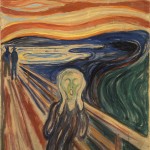
Can music scare? Why some dissonant sound combinations frighten? Have you experienced the music compositions that would make us scared? How did you feel? Thank you for sharing your views! Looking forward to hearing your opinion and feedback!

800px-Edvard_Munch_-_The_Scream_-_Google_Art_Project

Music is all about emotions. Composers know how to evoke emotions through their intuition. However, emotions range from the positive feeling of happiness to fear and panic on the negative scale. Music can scare! The frightening effect of music brings the feeling of suspense and enriches our emotional experiences. The best example is the use of music in film industry, the famous shower scene in a Hitchcock thriller “Psycho”. Listening to this video scares. You can try it with and without sound. The impact is big! We hear much dissonance. But why do these simple musical tones have such a scaring effect on listeners?
Scientists came up with a conclusion: dissonant harsh sounds can invoke a deeply ingrained instinctive response. There is a connection between the suspense music and the screeches of frightened baby animals in distress. The Amygdala – almond-shaped structure in our brain is responsible for figuring out where we should be afraid of something. If the answer is yes, it fires all signals getting the body ready to run or fight. It is a natural biological reaction.
Daniel Blumstein is a leading scientist on this study and he is an expert on animal distress calls. He analyzed the link between screeches of different animals and soundtracks from movies. He also found that when the melodies suddenly became higher, there was greater emotional stimulations than in the moments when the notes went lower. It is also connected to the fact that when we are frightened, our voices get higher due to more tension in the vocal cords. Apparently, visual stimuli dominate the audio stimuli, so the effect would not work if we pair the harsh dissonant music with pictures of fluffy teddy bears.
It is interesting that music theorists in the Middle Ages suggested to composers to avoid certain combinations of notes like the triton (two notes with three whole steps apart like F and B) so as not evoke negative emotions. This triton was even called devil in music (Diabolus in musica).
Researchers also agree that the music mostly becomes emotionally colored through context and associations. It makes me think of Requiem and Dies Ira (Day of Wrath) – the lyrics of the catholic mass remind us of the terrible Judgement day and composers like Mozart and Verdi knew how to make this movement sound really strong and frightening. There are examples by Modest Mussorgsky “Songs and Dances of Death”, Danse Macabre by Camille Saint-Sans, “Dance of Death” by Franz Liszt – there was a macabre fascination by fear of hell. In contrast, the music of Johann Sebastian Bach „Toccata and Fugue in D-minor,” did not sound scary until it was used in movie like “Dr. Jekyll and Mr. Hyde”.
Some music techniques like speeding up or growing louder could help our imagination to feel the danger or hint that a character is being chased. The use of dissonant tones, the jerky sounds that come and go abruptly, much percussion, high-pitch disturbing sounds bring the feeling of fear into the music. Changing dynamics and the deliberately chaotic structure of the piece can send the chills down our spine. The rhythm is very important – it is associated with the footsteps, ticking clock, heartbeat, breathing you name it! Hearing unfamiliar strange sounds can also sound very weird. So many composers use unusual instruments or play instruments in unusual ways. It makes me think of John Cage or George Crumb and their compositions for prepared piano.
These days we have sound designers whose job would be to create new sound combinations to serve the purpose.
Have you experienced the music compositions that would make us scared? How did you feel? Thank you for sharing your views! Looking forward to hearing your opinion and feedback!
Von Edvard Munch - Google Art Project: pic, Gemeinfrei, https://commons.wikimedia.org/w/index.php?curid=37624942

Country:

Posted in Uncategorized and tagged , , ,

Blog about the silence, fresh air, leisure activities and why they are so important

20160403_140646

Last weekend I spent hiking in the mountains and enjoying the fresh air. The weather was sunny and beautiful and there were many people outside. They were hiking, riding bicycles, motorcycling, climbing the mountains, paragliding, fishing, riding cars for fun, jogging, picnicking…People were enjoying their leisure time.
‘We work,” Aristotle wrote, ”in order to have leisure.” Today, this is still true. There have always been breaks from the routine of work-taboo days, market days, public festivals, holy days-we could not survive without them. Leisure has historically been the privilege of the rich. Opportunities for leisure came with more income and less working hours. I noticed this change in Russia when at the turn of the century people started doing more outdoor activities and developed interesting hobbies.
We all need a break from our daily work, household chores and the routine. The recreational activities can work wonder! Scientists discovered that walking in nature causes brain growth in hippocampus region resulting in better memory. Evolutionists explain that a walk in nature sparks our spacial memory exactly the way it did when our ancestors went hunting! It gives our brain uninterrupted focus and helps memory consolidation.
Walking in nature has even more advantages! It brings back the silence in our lives! Being a musician, I realized how important silence is. We are constantly surrounded by various sounds and noise. Just think of air conditioning or refrigerator. When you are a musician, you are exposed to thousands of different sounds depending on instruments; some might be even very loud. We are listening to music, analyzing music, making music ourselves. Our ears are overflown by the acoustical information. Apparently shutting off the faculty of speech heightens the sensitivity. So we are regaining the quality of being sensitive to the sounds, which is of paramount importance for any musician! Through silence, our focus is being shifted to our thoughts, emotions, and sensations. Psychologists could prove that our empathy has limits and needs to get a fresh start too. If we are burdened by the daily problems, we lose the ability to perceive, interpret and process emotions, be it our own or somebody else’s. It gives us an explanation why many composers took long walks and searched for solitude and silence. It makes me think of Beethoven – a restless walker who would hike for hours just to end the day with a great idea of a new sonata. Nature retreats can be very inspirational: psychologist Kelly McGonigal says that during hiking we are able to cultivate a form of mindful intention. If we couple it with the refreshing effect, we can easily see why we are back to work full of energy and are fully motivated to take action.
Free time activities are the best creativity training we can get! Free time moments are perfect for incubation time and absorption time any new material or information needs. There is life outside of music! It is up to us to make the best out of it!

Country:

Posted in Uncategorized and tagged , , , ,