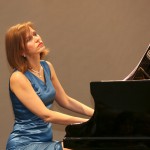
Being a musician and an avid visitor of classical music concerts, I would like to think about the questions: will the nature of the audience change the way musicians play and.. for whom does one actually play?
There is a story about a famous piano virtuoso and composer Franz Liszt who was criticized by playing Bach in public. Liszt was a brilliant performer and his answer to this was three different Bach performances: one as the composer would have played it in public, then more personally, as he played it for himself, and finally, as an imposter for a grand public – all this while smoking a cigar with great enjoyment (Charles Rosen, “Piano Notes: the hidden world of the pianist”) It is clear from this story that Franz Liszt had several performance styles and could interpret the piece differently. The second time I thought about different performance styles of the same work was through an interview of Yuja Wang when she said that she did not want to repeat herself by playing so many concerts with the same program. She wanted to remain creative and motivate herself through discovering new aspects of her music. Yesterday was the third time that brought me back to the topic of different interpretation of the same piece for different audiences when one lady from the audience thanked me for playing George Gershwin “The man I love” “differently than my YouTube video” where she heard it for the first time and found it sounding “more dynamic”. I was surprised as I did not change anything about my interpretation but as it was a private event with a certain motto; I just wanted to play the piece as if the salon lady would have played it herself. Apparently, a small change in the direction of the communication helped me to hear this piece differently too.
Will the nature of the audience change the way musicians play? This question fascinates me, especially as these days the musicians take over the marketing concepts into their work. The idea of public performance of music compositions was born in the 19th century. It is difficult to imagine but Beethoven sonatas were not performed for large audiences during his life. The 18th century music making always had the music performance within the social context – just think of the “Tafelmusik” played in the court of noblemen, for example. Franz Liszt introduced an idea of solo recital for bigger audiences. As there were more and more people willing to listen to the music for the music sake, the public performance has become a standard medium for presenting a work of music. In a way, it is still the only aesthetic criteria for many musicians who strive to be performing artists. Public playing in a concert hall takes the music compositions out of the context, it makes them even more abstract and turns into an object that can and should be judged. It was a beginning of the music journalist and music criticism. In a concert hall there is a clear division of roles with a performing artist who has a name and a personality and an anonymous audience. In the salons, for example, the guests know each other and there is a conversation with the artist before or after playing. Today, If the lights are dimmed in the concert hall, a musician cannot even see the people in the audience or recognize faces. Unlike the singer or the violinist, the pianist does not even face the listeners while playing. Does it mean that the musician is not even aware of the audience during actual playing? It sounds like a paradox but I would have less stage anxiety in bigger rooms and where there is a physical distance between the stage and the audience. Introducing the music to the audience before starting playing a group of pieces reduces the formality of the event but it is an awesome experience too as you can feel the difference between playing and talking. During talking, you face the listeners, see their facial expressions and get an immediate reaction. Our brain registers the visual feedback within milliseconds! During the actual playing, the only way of getting the audience reaction is to listen to the sounds the audience is making. It can be shuffling, coughing, breathing, but the quieter it gets, the more mysterious the atmosphere gets. The degrees of silence gives an orientation for the audience attention. Charles Rosen has a very clear view on coughing that he considers a sign of inattention and not a sign of low winter temperatures.
The musical performance is all about the non-verbal communication that leads me to my next question: for whom does the artist play? Does he or she play for everybody or for nobody, perhaps for oneself? There is a ready answer that the artist plays for music but it brings even more questions with it. If the artist plays for music, then playing alone in a room would be enough? A direct undisturbed dialogue with the music? Anna Netrebko said in her interview once that anybody who experienced being on stage even once, would want to come back, it is like a drug that brings the artists back onstage – just thinking of an 82 year old Horowitz who would go back to public recitals from 1985 to 1987 after a break of 16 years. In pop music culture, we have the whole bunch of old generation musicians like Eric Clapton, Rod Steward and Paul McCartney who venture out new concert tours again and again.
American pianist Julius Katchen had his method – he would single out one person in the audience when he came first on the stage and he would send out his playing to this person. It is a known psychological trick – usually there is always at least one positive person in the audience who would smile back, nod back and show in an open and friendly way that he or she is really enjoying your performance. It is a question about the energy and if the audience is sitting with reserved attitude, the musician is going to feel it too.
I think the trend is come back of the Biedermeier times and a certain longing for retreat into a private world of simple pleasures and individual music experiences. I use the term “Biedermeier” to refer to more safety, staying at home and enjoying the home, finding more attractions in one own country. There is an increasing number of private and semiprivate musical events. The culture of salon is experiencing revival too. In home music making is getting more and more popular. As the classical music market is oversaturated, there are more and more professionally trained musicians who are not able to earn money through public performances. The so-called music amateurs with a high degree of musicianship blur the borders between the commercial and non-commercial music making. The locations for public concerts are getting more creative too. Imagine an Internet page where you can book a ticket for your favourite musician playing Beethoven in a flat xy just a couple of meters away from your domicile? (It is a reality in USA http://www.concertsinyourhome.com/ ) The idea of the public concerts “at home” was born out of the conflict of interest. On the one hand, you have an audience – people who are paying money and dedicating their free time to one person who is providing “musical services”. The audience wants to get inspiration and have a quality time. On the other hand, you have the artist who is doing the job and who is under pressure to perform. The abstract music needs the context, sometimes the occasion helps too. Friendly atmosphere can make Mozart piece sound up-to-date and take away the paleontological feeling that some might get in a traditional concert. The spur of the moment feeling and the degree of improvisation can bring back the freshness of otherwise only “historical” interpretation. The imperfect performance is allowed and the beauty of individual interpretation can blossom!
What are your thoughts? Will the nature of the audience change the way musicians play? For whom does one play? Thank you for sharing your thoughts and an interesting discussion!
Posted in Uncategorized and tagged classical music, composers, language, listening to music