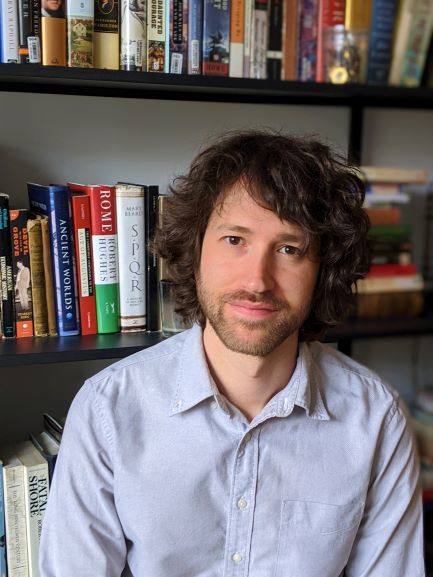
Jason Olshan

Composer

USA

Author

About

Jason, a native of New York City, began his musical pursuits at age 11 when he received his first guitar. With his first three chords under his belt, he began to write simple songs in the style of 60’s and 90’s rock music. At the end of high school, he co-founded a band called The Middle Eight, in which he would eventually write the music for three albums. His song Love; Pass It On, was featured in the Catherine Zeta-Jones film, The Rebound. With the Middle Eight, Jason also composed the music for a rock opera based on H.P. Lovecraft’s short story, The Music of Erich Zann. Jason also grew up with a love of classical music. During high school he met the celebrated Argentine classical guitar composer and performer Jorge Morel, who happened to live down the street. His studies with Mr. Morel led him to attend the Whalen conservatory at Ithaca College, where he studied with the guitarist Pablo Cohen, learning to write for the piano and experimenting in music composition. These collective experiences and musical influences would help to shape the sound of his music. For example, a later Middle Eight song called Master Raro, about the composer Robert Schumann, is equal parts classical suite and rock song. Recently, he has composed a growing list of music for classical guitar, the piano, and other ensembles. He looks forward to writing more music for TV, film, video games, and any other occasion.

Sheets

Interview

What does music mean to you personally?

Music is an important part of my life. Whatever I’ve done personally, or professionally, music has been a constant. It’s been a source of inspiration, an avenue for creativity, and a way to be social.

Do you agree that music is all about fantasy?

I think that music is often written to help composers, and listeners alike, take a momentary break from our world. It reminds me of the Beatles song The Magical Mystery Tour ​ on the album of the same name. The lyrics “the Magical Mystery Tour is hoping to take you away”, feels like an invitation to visit the fantastical world they created on that album. Robert Schumann provides another great example. You can’t listen to his Fantasie, Op. 17, or his Fantasiestücke, Op. 12 without going on a journey with him. He even puts the word fantasy in both of these titles. Personally, I like the fantasy aspect in music. To be able to conjure other moods and worlds without ever leaving your home feels like magic.

If you were not a professional musician, what would you have been?​

My day job is teaching history, another subject I’m passionate about, at a high school in New York. That’s probably why music history is so interesting to me. I also teach music privately.

The classical music audience is getting old, are you worried about the future?

Yes and no. The audience may be getting older at the concert hall, but there's no lack of love for classical music among young people. Comment sections on YouTube videos of classical music are filled with the thoughts of people of all ages. Sites like GroupMuse set up chamber performances in the homes of everyday fans. Musescore has many young composers writing scores. Many people, adults included, still have an opinion about classical music as a monolithic, stuffy, inaccessible tradition that requires too much attention. While it’s true that some classical music asks for a closer listen, composers in the past wrote music for all sorts of occasions, just like they do today. In the end, I don’t think the love and appreciation of the music is dying.

What do you envision the role of music to be in the 21st century? Do you see that there is a transformation of this role?

People will contin​ue to observe the world, their lives, their experiences and add a melody, some harmony, rhythm, and a form to it. Some of it will have the power to hit us emotionally. Some of it will be an intellectual challenge. Some of it will be for dancing.

Do you think that the musician today needs to be more creative? What is the role of creativity in the musical process for you?

​I don’t want to say that some music is less creative than other music. I know from experience that writing a good pop song is no easy task. I would say that different types of music open up different areas of ourselves to explore. What I love about a lot of instrumental music from the 19th century (and I don’t mean it’s all amazing), for example, is the combination of emotion, intellect, technique, and creativity. Listening to music where all of those elements are at work is powerful.

Do you think we as musicians can do something to attract the younger generation to music concerts? How would you do this?​

I think composers should focus more attention on trying to bridge the gap between their craft and the masses of listeners in the world. I strive to write music that is complex in some way or another, yet still accessible. I want listeners to have a novel listening experience that doesn’t alienate them. Modern classical music should be relevant to the world, without having to sacrifice the things that make it unique.

Tell us about your creative process. What is your favorite piece (written by you) and how did you start working on it?​

I usually sit down at the piano, or pick up a guitar and just start playing. When I find an idea I like, I try it in several different ways. Development is important if you want there to be some sort of journey. So where is this idea going to go? Where does it end? I start notating what I have when I feel like I’m getting stuck. I may take a few days off. Coming back brings a fresh perspective which can really help move things forward. I don’t really have a favorite piece, at least at this point. I find that when I manage to finish a work, I’m mostly thinking about what I can do next. But of course I hope people will hear and enjoy it.

Can you give some advice for young people who want to discover classical music for themselves?​

The good news is that you no longer have to spend money to hear a great performance. On YouTube you can listen to recordings of the great symphonies, or those by more obscure composers. You can even go back in time and experience a Mahler concert with Leonard Bernstein conducting. My advice would be to start small. Don’t listen to too much too quickly. Give yourself a chance to absorb something new. Reading about the time period and context in which a work was written can help you to hear it almost like people back in that period heard it.

Do you think about the audience when composing?

Yes, while I enjoy writing music on my own, it ultimately comes down to the desire for other people to listen. This is especially true when I get bogged down in the middle of a piece and can’t figure out how to finish it. At those times, I often wonder why I put myself through the struggle. The knowledge that other people might hear the music and enjoy it, gives me the motivation to keep going. Without that I would have given up on many projects.

What projects are coming up? Do you experiment in your projects?

I’m working on several different projects. For one, I’m trying to write more of these Lapses for the Piano. I’ve written two so far. They’re meant to be short and evocative daydreams that people can play without too much difficulty. I’m finishing up several pieces for classical guitar, which was my area of study in college. I’m also working on a set of music for an RPG. Video game music is providing an amazing outlet for composers to write today. While there’s no game for this particular music yet (I’m open to offers from video game developers who’d like to use it), it’s basically a soundtrack. I was inspired by Nobuo Uematsu's Final Fantasy soundtracks. These works are written in that vein. I definitely do experiments because I want to see what I’m capable of. I also don’t want to repeat myself.