Classical music and locations: how to make an event out of a traditional classical music concert

Williamsburg1

The other day I was watching TV programms with different musicians like Lang Lang in Moscow Conservatoire and Piano Guys in London Arena and both programms reminded me that there is nothing like going to a live music concert. When we attend a concert, we become a part of the concert. We could feel very different energy coming from the musicians and the choice of the location is very important. The architecture of a venue influences the music enjoyment and determines the character of the concert.

Much has been said about the big concert halls: the audience growing older and danger of not selling enough tickets… Playing big needs big names, big money and big risk for the agents. Big concert venues have their own life and could be even considered a part of tourist programms. However, the classical music concerts take place not only in traditional concert venues.

The role of a modern musician is to search for his/her audience in the places where people are spending their time and make their music appreciation experience more enjoyable. There are different ways of making an event out of a traditional classical music concert: you could work on the choice of music, on the presentation form, add special features, combine different artistic disciplines or you play in different and unusual locations. The gurus of music business keep saying that classical music market is not rigid anymore and it keeps changing. It is time to go new ways, get an inspiration from outside and be the first who is brave enough to try it. The best way to get an orientation how to approach a broader audience would be to get help from the sociological studies.

Several studies describe the population groups and their life styles. It is interesting to read that the traditionalists and conservative establishment prefer the big concert halls and big names. But they represent only 20 % of the population. Classical music admirers are not only traditionalists. It gives hope that musicians can reach more audiences!

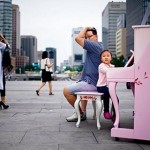
The first example that comes to my mind is the office “after work” parties and business lounges – just think of putting piano in the office, organizing some drinks and offering some music at office premises. The families with kids are interested in the events that involve the whole family – they like museums and exhibitions, family shows with the combination of some educational topics. Hedonist groups enjoy good food and wine – so the restaurants and wine shops would be a nice place to present your music. Intellectuals like literature forums, museums and art galleries. What can be more enjoyable as a music concert to accompany literature event or vernissage? The so-called high performers like luxury brands and prestige: Surely, the classical music with its perception as high-class entertainment fits well to the product presentation of luxury shops and brands, car shows and noble furniture, jewellery and design clothes. But the selection of locations can get even crazier: there is a possibility of open air concerts at lost places, garages, former factories. There are abandoned fortresses, castles, undergrounds. The people interested in sports could appreciate more music in golf or surfing clubs. As you can see, the possibilities are unlimited. And this is just a beginning. All it takes is to be creative. Richard de Hoop said that the success of any show is to combine the profound content with the entertainment and start where the audience is ready to start, “give them all you have got”. Bringing the music to the unexpected places shows that the classical music can be part of everybody’s life, might take away a fear and what is important; it shows that classical music is truly fascinating.
Internet page www.movingclassics.tv has a tab called LOCATIONS. The idea behind this section is to share all interesting and unusual places for classical music concerts you experienced yourself or are dreaming of visiting.We would appreciate it if you upload your pictures and share with the classical music community these locations.
Thank you for reading.

Country:

Posted in Uncategorized and tagged , , ,

Djamileh, Bizet's first mature opera, came right before Carmen. Its music is rich, sensual and beautifully orchestrated, totally worth the listening.

Djamileh

Here I am, yet again, deeming with the intricacies of a period of time I particularly love: Paris in the second half of the 19th century. This era has always fascinated me: it’s the time of Rodin and Camille Claudel, of Debussy, Mallarmé, Verlaine and Rimbaud. And, of course, the time of Wagner’s Tannhäuser in its catastrophic French debut (160 rehearsals and then some for 3 performances!): this started a querelle between pro-Wagnerian and anti-Wagnerian that would last until after World War I. Georges Bizet came up as the quintessence of anti-wagnerism with his most famous masterpiece, Carmen, endorsed by a Wagnerian of the first hour like Nietzsche, who, as much as was a fan of Wagner in his early years became later one of his most poignant critics.
What captured my attention this time is a rather obscure one-act opera by Bizet: Djamileh. I bumped into it by chance, looking around the web for something totally different.

Carmen has had the merit of making Bizet immortal, but also the flaw of obscuring most of his other works. And yet, Djamileh, written one year ahead of Carmen, was greatly admired by Gustav Mahler, who programmed it and conducted it in Hamburg and Vienna, and, later on, by Richard Strauss, who viewed it as a source of inspiration for his Ariadne auf Naxos. At its first production, though, it was a flop, targeted by the critics as drawing too much from Wagner (quite ironic). The opera disappeared after a handful of performances and is today unknown to large audiences and musicians alike – personally, I had never heard of it till a few days ago.

Bizet himself was aware of the fact that the first production of Djamileh was everything but a success: but not because of the music; too little action and a bunch of so-so singers who barely knew their part, to the point where the soprano skipped some 30 bars in one go. Yet, this first mature opera of Bizet respects all the canons of the time: an exotic country, the rhythm and colors of its music mixed with french tradition, colorful settings and room for a ballet.
Bizet was not much of a traveller, but Djamileh, like most operas of that period takes place in a foreign country: librettists tended to set operas in countries where French economic interests were strong. Like every good artist, he travelled with his imagination: the opera sets the mood right from the start for a fairy tale, in a Cairo palace with backstage choir and smoking water pipes with Bizet overcoming the lack of action in the libretto with evocative music and wonderful orchestration. This is certainly one of those works that would deserve to be revived.

Oh, and for once, I like an opera in which nobody dies!
Here’s a (vocal) score of the opera: https://archive.org/stream/djamilehopraco00bize#page/n5/mode/2up

and here‘s a YouTube link: https://www.youtube.com/watch?v=SBgp-vBQuLw

Enjoy!

http://www.gianmariagriglio.it/bizet-djamileh/

Country:Italy

Posted in opera and tagged ,

UpperHandsPiano.com/blog is dedicated to the needs of the over 50 pianist, as well as piano teachers interested in teaching older adults. We offer free monthly sheet music, practice tips, and give you the latest information on music and the brain.

Hot chocolate (auld ange syne)

Now that the holiday season is well underway, we will soon be welcoming the new New Year with wine and song. Our easy arrangement of Auld Lang Syne (for piano, vocals, guitar, bass, and G-clef instruments) will help you to start 2016 on a sweet note! The arrangement is from our Songs Of The Seasons: Winter book, which is a collection of classical and popular winter favorites. To download and print Auld Lang Syne, click here:

http://wp.me/p3StCV-er

If you scroll down to the bottom of that sheet music page, you will also find an arrangement of the holiday favorite, Joyful, Joyful (which will only be available until the end of December! So download now :) )

Country:USA

Posted in Piano and tagged ,

Essay about the rise and fall of classical music based on the examples of China and Russia

china piano

Last week after a concert I spoke with the man who was telling me with a big smile in his face about his visit of a small Siberian village in Russia in the 90s where he participated in a festival of the “Dom Kultury – House of Culture” with hundreds of Russian kids who were making music and dancing ballet! He was fascinated by their high level of musicianship.
His words brought back my memories of my first steps in learning piano in Siberian town Tomsk. I was lucky enough to be born into the musicians’ family and I enjoyed the benefits of the governmental music education programs before there was a big change. The Russian vocal tradition goes back to Orthodox singing; just think of the deep bass voices with a dark timbre. Peter the First and the Ekaterina the Great were eager and intelligent rulers who would invite the best Italian and French musicians to the Russian court. The Soviet times gave a push to the music culture in Russia. The idea behind the democratization of the music education was fruitful, hundreds of new concert halls were built. I know it from my grandparents who managed the wood factory that their task was also to make sure that the workers get access to cultural heritage. They would organize the literary and musical evenings where everybody was encouraged to prepare an artistic contribution. Svjatoslav Richter, a famous Russian pianist, had to travel through Siberia and Far East to give piano recitals in the factories, schools and hospitals. The tickets were affordable, surely people were obliged to attend certain events but on the other hand, the power of music was so strong that a number of new music schools appeared and it was en vogue to learn an instrument. The Perestroika and big political changes shifted the focus in the 90s. The old structures fell overnight and the big country faced new challenges. The demand and supply rules of market economy touched upon the music scene. The concert halls became nearly empty. The kids were learning foreign languages and the essentials of business and definitely not piano. The image of a musician changed and it was regarded as not something you would desire for your kids to pursue…
The Russian piano school still has a high reputation and old Russian professors have been teaching all over the world. But times change – and 20 years later you would find Chinese Professors teaching piano in Russian schools and Universities… Why Chinese? An Internet research gives stunning figures: China has currently 40 Million kids learning a music instrument. If I browse through the concert programs in Germany, there are many famous Asian names. Every second music student in Germany is Asian. But how come that China became so important in classical music scene?
The curiosity led me to do some research on the piano playing tradition in China.
A surprising fact is that the Italian Jesuit missionary Mattheo Rucci brought the first western musical instrument (namely, the clavichord) in 1601 to the Wan Li Emperor. Surely, the China had a variety of music instruments then but there was no instrument of the keyboard type at all. After the Opium War (1839-42) Protestant missionaries began to enter China in large numbers and they established schools in which they used pianos for teaching purposes. The first piano shop was opened by the 1850s in Shanghai, at the beginning of the early 20th century piano education was already spread, particularly for young women in cities like Shanghai. Early piano teachers were Westerners, like the Italian conductor and pianist Mario Paci who sailed into Shanghai in the winter of 1918 along with his Steinway grand piano. Another important figure in Chinese musical scene was Alexander Tcherepnin who wrote in 1927 in Shanghai Conservatory the first piano book based on the pentatonic scale (typical for Chinese folk music) and encouraged Chinese composers to create music in the tradition of Western classical music that sounded Chinese.
By 1949, there was a well-established tradition of piano school in China and here is the quote of Mao who said in his state speech: “Learn to ‘play the piano,’” Mao told a group of cadres. “In playing the piano, all 10 fingers are in motion; it will not do to move some fingers only and not others. However, if all 10 fingers press down at once, there is no melody. To produce good music, the 10 fingers should move rhythmically and in co-ordination” He literally wanted his people to put fingers on the problems and solve tasks with the same firmness and rapidity as pianists, develop coordination and multi-tasking through playing an instrument. That was the first time in the history of China where the government officially acknowledged the benefits of learning an instrument for the people. The first successful Chinese pianists were the winners of the international competitions in the 1950s Zhou Guangren and Fu Cong. Here is a youtube of Zhou Guangren from 60s with some Chinese piano music https://www.youtube.com/watch?v=mZBrjdfRfMY or you listen to the 3d movement of Chopin piano concerto No. 2 by Fu Cong in 1963 https://www.youtube.com/watch?v=WFtojvXat7I The next 30 years the classical music fell out of favor until the political changes in the 90s. New government put music education as the high priority. They spent millions and millions for establishing the infrastructure for making music an important part of the basic public education.

Nowadays the music making is considered officially a skill that is helpful for social competition. Yuja Wang, a famous pianist, says that “Music, in the Chinese mind, is the most sublime thing you can do”. Lang Lang explains the piano boom in a more pragmatic way: “The Chinese like celebrity And when they see a pianist making an impact on the public, they think, ‘That’s cool.’ Otherwise, they think it’s boring. „Surely, many parents see through an instrument learning a way for their kids to make a better living, move to Beijing from a small village or US university for studies. It is also a high-class symbol if you have a piano in your place. The Chinese audience is also willing to pay for classical concerts. New concert venues were built and the Chinese society takes a vivid interest in the development of the careers of Chinese musicians.
Two examples, Russia and China, went into different directions in classical music scene in the last 20 years.
Thank you for reading.


Country:

Posted in Uncategorized and tagged

The conceptual opera “Audioguide III”, by German composer Johannes Kreidler, ends with the disruption of 66 violins. Does this serve the Kantian philosophical underground of the work?

12175664573_2191745ea1_o_d

Wandering around the internet, one can make some quite unexpected encounters. My most recent one has been with German composer Johannes Kreidler. I had never heard of him, despite the fact that he seems to be quite accomplished. What captured my attention was the video of his Music Theatre piece Audioguide III, which you can find here in its entirety: https://youtu.be/OJWDrNNYFmE

Now, I confess, it took all my good will and then some to listen to the whole thing, but I honestly wanted to give it a chance to see if the end of the piece was somewhat justified. After all, you don’t get to see that kind of spectacle every day. As the author describes it on his website (http://www.kreidler-net.de/werke/audioguide3.htm), this is a conceptual opera, a collage of the present built on small and large modules, different every time. Infused with philosophical essence, the climax should be a cathartic destruction of 66 violins.

This is where I have a problem: how is it cathartic to demolish a work of art? I’m sure these were inexpensive factory instruments, but even those hold, at their very core, 300 years of expertise, science and craftsmanship. Let’s pretend that this was not a relevant issue; another question I have is: what kind of message is passing on with this piece?

As stated by the composer, emotional forces, trauma and revenge lead to these actions, associating the ravages with a mix of pleasure and pain. One could argue that the history of opera is full of ambiguous models and that, after all, this is just one more to add to the pile. However, Kant, who seems to be a fil rouge throughout the piece, is, in my opinion, distorted to support the composer’s thoughts – or, worse, to justify intellectually a pure spectacle that otherwise could not be backed up by any logic.

The feelings of the beauty, cited by Mr. Kreidler, are for Kant always joyous and smiling. Maybe he is referring to the feelings of the sublime, which can provoke enjoyment but with horror. And this is where he falls short in his association of beauty or sublime and catharsis: given the day-to-day horror show running under our eyes in the news, who could enjoy or take any more of this destruction orgy? Since when violence became cathartic?

Perhaps I am too naive, but destruction only makes me sad or angry, I do not find beauty and certainly not catharsis in it and I surely hope other people do not either.

Country:Italy

Posted in opera and tagged , ,

Who says opera should only be staged and performed by big opera houses? Small opera companies have the capacity to refuel people’s attention on this art, breaking the rituals and engaging new and old audiences.

sydney-opera-house

Who says opera should only be staged and performed by big opera houses? When it comes to small opera companies there is a certain preconception – coming from a pure comparison of budgets – in looking at them as second rate producers: what the Met or La Scala spend on one production, a small opera company spends on its whole season, hence their shows must be inferior in quality.

This is not quite correct: true, there is quite a number of small companies that disgracefully sell low budget productions of Elektra or Aida by simply cutting off on the number of players or eliminating the choir. But others, with some well planned budgeting and smart choices, are able to put on great productions.
Take the recently defunct Gotham Opera in NYC: the company sunk probably due to some bad management, but the productions they had were far from amateurish.

LoftOpera went head to head with the Met with a production of Barber and they got praised by the New York Times not only for their effort but for the high level of the outcome. Peter Gelb himself had nothing but good words for them. On this side of the ocean, OperaUpClose in London is getting rave reviews for its bold take on classics as well as new works.

In a way, small opera companies have most chances of succeeding than their bigger sisters (look at what happened to New York City Opera), mostly due to the fact that their budgets are more sustainable and they often present niche products, whether they do traditional operas in unusual spaces or less known/contemporary works. Audiences are often attracted by their shows because of the less-formal-feeling and the idea that they are more part of the show instead of just looking at it from a distance.

The real worth of small opera companies is their capacity to refuel people’s attention on this art: they know they have to rethink the concept of traditional opera in order to survive, break the rituals and engage new and old audiences in a time in which it seems to be needed the most. Something the big theaters way too often delegate to weird and unimaginative staging, hoping to create some buzz and sell some more tickets.

Country:Netherlands

Posted in opera and tagged

Some personal thoughts about music and intuition based on listening to the recordings of Maestro Horowitz

Vladimir-Horowitz

“The intuitive mind is a sacred gift and the rational mind is a faithful servant”. Albert Eistein
One day I was studying the danse macabre of Saint-Sans and listening to the recording of Wladimir Horowitz. When I was reading the music during my listening, I realized my expectation of the music was different as all the corporal strict notation in the score was very freely interpreted. I tried to play along and had difficulty to follow him. Then I put the music aside, closed my eyes and listened again and suddenly the piece started living. It was amazing, how fresh and energetic and alive it sounded! Every note was captivating and I could not stop listening. Then I stood up and tried to dance to the music and do some arm and hand movements and was fascinated how organic the music performance was. It seems like Horowitz released an internal flow out of the written dead and dry ink on the paper.

Italian Humanist of Middle Age Leon Battista Alberti (1407 - 1472) once said, “We shall borrow all our rules for our proportions from the musicians who are the greatest masters of this sort of numbers and from the music itself wherein the Nature shows herself most excellent and complete.” In the Middle Ages the liberal arts education consisted of Music, Arithmetic, Geometry and Astronomy, the so called Quadrivium. Surely, at first the educated person would learn to master a musical instrument due to the mathematical and proportional aspect of music. Even then, it was all very clear that actually playing music or even just hearing it would foster a creative moment – that would boost our instinctive facilities. At first, it sounds like a contradiction: Music has numbers, proportions, strict rules and they all need to be obeyed. Playing music is all about the intuition, inborn unexplainable facility to shape these numbers and harmonic proportions into tones. The magic moment of flow occurs when everything starts fitting it – your body movements, your state of mind, emotions and your personal something…

My personal experience was many times I had difficulties with some music pieces and would be searching for analytical ways to cope with them. I would be doing everything written by a composer but still the essence of the music would escape. Only a source of inspiration like reading a book, or walking in the forest, or dancing to the music would give me a key to my interpretation. New impulses would arrive when I allow myself enough room for improvisation in my interpretations. Maestro Horowitz once said that his idea of a most interesting recital would be to play several performances of Ballade nr. 1 of Frederik Chopin in one concert. So improvisation and intuition go hand in hand. Both are so important in life, and they are certainly a product of self-contemplation which is developed through artistic practices and music in particular.
There were several postulates that the ability to read music and play different musical instruments teaches pattern recognition allowing for faster conceptual mapping enhancing intuitive abilities. In other words, it strenghens our intuition. Kay Shelemay, Professor of music in Harvard says, “All humans come into the world with an innate capability for music. At a very early age, this capability is shaped by the music system of the culture in which a child is raised. That culture affects the way people hear sound.” However if it is not developed further, this ability stays under cover, only to be re-discovered later eventually through the conscious effort. One way to bring intuition back into your daily life is through short creativity breaks.
It would be interesting to hear your experiences. Does intuition help you and/or how do you make use of it? It would be great to hear your opinion. Please visit us at www.movingclassics.tv for more insights. Thank you for reading.

Country:

Posted in Uncategorized and tagged , , ,