Do women suffer discrimination in music? Could you hear the female touch by listening to pianists with closed eyes?

anna blog

Once I played a recital and was approached by a gentleman after a concert who asked me with an expression of surprise on his face why there were so few female pianists. I immediately thought about the stars like Helene Grimaud, Martha and Katja but he was not happy with my answer. He wanted to go deeper. His argumentation was that the winners of the piano competitions are mostly men. I must admit I was at a loss at that moment what to answer. But the question remained open for me and did not leave me for days. The notorious joke of Horowitz about three kinds of pianists was in the air too….
The next “reminder” came two days later, when one agency asked me to call back a client who was looking for a pianist for dinner gala with classical repertoire, my joy disappeared within a second as a lady on the phone said that this job opportunity is open only for young male pianists.
The third time the same question re-appeared was a reader’s letter in the UK Pianist magazine; it was a question if there is something like a female touch and if we could tell from listening with closed eyes when a woman is playing.
All three incidents were a trigger for me to write this blog. To begin with, I asked befriended piano teachers in schools and universities about the gender distribution. The answer confirmed my own experience: it was 80 /20 percentage for schoolchildren, where girls were the majority. (Surely guys were doing sports in their free time). The music major faculties showed a different percentage, it was more like 50/50. I looked through the latest statistics of the competitions and it confirmed my own experience of taking part in them. For example, the recent Tchaikovsky competition statistics was that the third of the pianists were females (from 35 listed competitors) but the finalists were all men. The Chopin Competition was interesting to follow too: in the preliminary round it starts with 45% of women, and then the proportion diminishes. The third round has 35% and the grand finale only 20%. The figures were eloquent enough – I wanted to find out the reasons. Curious as I am, I consulted the youtube and entered Chopin Scherzo Nr. 3 in cis moll. I suggest you do it too: the results were fascinating, nearly all famous pianists of the past and even recent competitors recorded this piece. I chose Chopin as it has strong female component in it: But now we are back to the controversial topic. I am sure you will ask me to define “female” too. Back in the 19th century, the role of a woman and the word “female” was clearly defined. Clara Schumann or Cecile Chaminade were balancing their lives within the society where a woman was supposed to be taking care of the family and children and not pursue music as her career. Not so with the girls’ upbringing, it was a sign of good manners to play a piano. So a teacher (of course, it was a man) would come to give piano lessons.
Well, we are talking about clichés, it all starts in our early childhood when our parents pay attention to our education in conformity with the roles. When we speak of “female” qualities, the first associations that come to our mind would be sweet, sensitive, less aggressive, motherly, caring. ..The masculine qualities would be strong, daring, aggressive, risky… The thesaurus has no limits but the words are clearly defined. Music as a word sounds feminine to me, due to Greek mythology with 9 muses, the goddesses of inspiration of the arts. Euterpe was “rejoycing well” or “delighting” goddess of music. In modern language, the word “muse” is someone who inspires a musician. In the rock culture of 60s there was a phenomenon of groupies who were female fans following the music stars everywhere… This leads to another question, if the culture of being a fan and musician adoration cult is more of a “female character” phenomenon..
The youtube comparison of the Scherzo brought interesting results: after having listened to about 200 videos, I would say, yes, women tend to take slower tempi, they are more sensitive in the lyrical passages, they phrase differently, they pay attention to more details, men tend to be better at big forms, they have clearer structure and concept feeling, they are louder, more aggressive, faster. There are two exceptions: Martha Argerich and Krystian Zimmerman, but as the old saying goes, the exceptions prove the rule. Another thought would be, if the male composers wrote the music in a “manly” way, then the men would best understand it? I often heard from many people that female pianists cannot be good at Rachmaninow as they would not possess the strength and stamina to get through the concerts. We all heard the stunning performances of Tschaikowky Piano Concerto by female pianists. Men would often say that the sex appeal would make it easier for women to get attention. But the experiences of Rubinstein, Liszt, Pollini and many young 20 year old pianists show that their sex appeal work exactly the same way for the female audience and if you take into consideration that the classical music audience is getting older and women outlive men, you get exactly the gender preferences.
What is your opinion about this topic? Is there discrimination in music business? Do you perceive music differently when played by a man or a woman?

Country:

Posted in Uncategorized and tagged , , , ,

What recent scientific studies tell us about the effects of listening to music

jange austen hands

There are many articles about the benefits of learning a music instrument and playing but what about listening to music? In the Internet you can find scientific studies concerning the influence of music on our health. They all show that music appreciation activities have many positive aspects.
Music consumption activates reward centers in our brain similar to chocolate and helps to release dopamine and reduce anxiety and stress and even ease the pain. Some scientists say that the pain-alleviating benefit comes from the fact that listening to music distracts you from concentrating on the pain. Depending on their character, some people can be easily absorbed in their activities and they respond faster to music by experiencing all forgetting state of mind, something we would call a flow. The extreme form of it is described by Beethoven biographers, they call it Raptus, a trance-like state when he was listening to music or composing his own.
The effects of listening to music can be compared to a purring of a cat –some research showed that music can lower blood pressure and ease muscle tension. Researchers from Finland did a study on the recovery of patients after a stroke and could witness a speedy recovery of those patients who would be listening to music for 2 hours a day. We all experienced that a right music in the morning can put you in a better mood and give you more energy.
Vocal music has more direct influence on our brains. Singing to a baby has been a tradition and Dutch scientists found out that the ability to discern rhythmical patterns and pitches is inborn and they say that listening to singing or soothing music can even be the first language lesson for a child and even help to prevent the language problems in the future. Later at school teachers would often see the correlation between high language proficiency and good music abilities.
The use of music for sports is well known too, we can run faster when listening to music, our body gets in tunes with the beats and keeping the rhythm can help us to keep on moving even after we are exhausted. The pleasing factor of music can be observed in fitness centers, shopping centers and even by telephone music.
But where to start? There are thousands of different music suggestions in youtube. For activity that would require high energy like running you could find youtube suggestions with fast pop music, with the strong beats.The relaxation music would often be electronic and use isochronic tones: tones that are turned on and off with the aim of causing brainwave frequencies to fall into step with a periodic stimulus having the same frequency as the intended brain-state . The isochronic tones can be incorporated in the classical symphony recording too. BILD
But what about use of classical music for studies as a boost for concentration and clearer and faster thinking?
While writing this video blog I was also listening to this compilation of Mozart piano concertos.

In comparison with the Lang Lang or Valentina Lisitsa youtubes, these classical music compilations have 4 times more clicks and we are speaking about millions! Interesting observation about these youtubes: there are no names of artists, no composers other than Mozart or Beethoven, no dates of recording, but thousands of positive comments.
And now my question to you is: what time of the day do you listen to music and what kind of music is it? It would be great if you could share your opinion with me at www.movingclassics.tv

Country:

Posted in Piano and tagged , ,

Poetry can be enjoyed in a poetic context. Robert Adams discusses musical semantics and structure, explaining how they are similar to poetry.

MrAMusicPlace Image

We all know that music is comprised of sound; however, many have argued that all sound is not music. Stravinsky advanced this view convincingly when he explained that when we simply hear the rustle of leaves or the sound of a brook, we are not hearing music nor are we utilizing musical ability to hear or even enjoy these sounds of nature. These sounds are “promises of music; it take a human being to keep them: a human being who is sensitive to natures many voices, of course, but who in addition feels the need of putting them in order and who is gifted for that task with a very special aptitude. In his hands all that I have considered as not being music will become music. From this I conclude that tonal elements become music only by virtue of their being organized, and that such organization presupposes a conscious human act.”

How do humans organize sound so that it becomes music? Stravinsky specifically mentions tonality, and that is one way in which we organize sound into music. Tonality is a culturally learned concept. Western cultures organize tones into major and minor tonalities, and less often into others such as Dorian or Mixolydian. Eastern cultures organize music into very different tonalities, but tonalities nonetheless. While Stravinsky’s observation of music as a human constructed entity, restricting ourselves to tonality will be of little help in a discussion of music and poetry, because poetry, as spoken language, has no tonality, at least in Western culture.

There are other ways that humans organize music. The two most significant ones are rhythm, meter, and phrases. These are elements that are critical to both music and poetry. In both disciplines, sounds are made that are of variable durations that are perceived in patterns. Whether we are performing a music, or reading aloud poetry, the notes or words respectively are heard in patterns of durations that we naturally form into groups of sounds that make sense to us, and make what would otherwise be a barrage of noise into intelligible and enjoyable art.

These rhythmic patterns in music, combined with tonal elements, result in musical phrases that end with a pause that marks the end of the phrase and signal the immanent beginning of the next phrase. An example of this is the famous “Ode to Joy” theme from Beethoven’s ninth symphony. The antecedent phrase ends with the longest duration heard thus far on a tone from the dominant chord, and the consequent phrase ends on a duration of equal length but on a tone from the tonic chord which in this case is also the tonic tone. That tonic note of finality punctuates the phrase with the musical equivalent of a period, whereas the end of the antecedent phrase on the dominant punctuates the phrase with the musical equivalent of a comma. Both phrases are of equal length and are comprised of identical rhythms. The structure provides a high degree of predictability that brings stability to our perception of the music. The effect is the same as a rhyme scheme in poetry. Rhythm, meter, and the rhyming pattern also bring predictability, at least that a rhyming word is coming, and of when the rhyme will occur within the established meter and rhyme scheme. In both music and poetry, when the predicted tone or rhyme, respectively, does not occur, tension is built; a tension that remains until the expectation is met.

There is an aspect of the similarity between music and poetry that goes beyond structure. I refer to the expressiveness humans achieve with both art forms. Leonard Bernstein discussed this extensively in his Norton Lecture, “The Unanswered Question” at Harvard University. Music can never have the literalness that language does, because no music has literal meaning. Musical meaning is always more abstract, and is come to through the interaction with not only the organizing mind, but the creative imagination. Prose, on the other hand, falls far short of such expressive abstraction, but not poetry. Poetry, like music, thrives on abstraction, illusion, and even at times whimsy. Poetry utilizes language in a way that replaces relative precision with literary suggestion that appeals to the human imagination.

If you are interested in reading more on this subject, I suggest Poetics of Music in the Form of Six Lessons by Igor Stravinsky, and The Unanswered Question by Leonard Bernstein. Both were lectures later published that each gave when they were honored with the Charles Eliot Norton chair at Harvard University.

Country:USA

Posted in Piano and tagged , , , , ,

Insights about the "Concert Experienced Amateur Pianists": people who live their passion of playing piano in free time.

12066062_10153628552613638_1471424597552938827_n

When Jeremias Mameghani, who is living in Düsseldorf/Germany starts to play the first notes of Liszt’s “Vallee d’Obermann” on the piano he seems to be very relaxed and not that nervous at all. As a listener you might have the expectation when you visit a piano recital. But Jeremias is not a “normal” pianist. Playing the piano and giving concerts is just a hobby for him. In his daily life he works as a self-imployed lawyer. Jeremias belongs to a group called “concert experienced Amateurs”.

Jeremias explained to “Moving Classics” that about 26 years ago the first competition for non Professional pianists, that means for those whose main income does not come from making music or teaching, was founded in Paris and is still held every year end of march. Since that the “Amateur scene” is growing and growing. Actually there are about a half dozen of competitions held in Europe every year, all two or even all three years. In the United States competitions are Organized in about six cities als well. Some competitions had to be cancelled again like Berlin or Vienna, other cities like San Diego / California are planning to establish a new one. Did you Know there is a Chopin competition for Amateurs in Warsaw all there years? The last one just took place in september, only 40 candidates from all over the World were selected. And there is also a Van Cliburn competition held in Texas all five years. Both competitions are a Highlight for all Amateur pianists. Being invited is a big Privileg, only the best Amateurs are chosen.
Jeremias tells, that most competitions are like a big come together of friends. Candidates know each other and keep friendships from Australia to Japan and from Russia to America. In Germany there are about seven or eight pianists who compete regularly. They feel like being a big Family. These friendships sometimes are worth more than an award in a competitions. Jeremias, who is also 1st Prize Winner of a competition tells, that he and his friends started inviting each other for Playing concerts. This is how you make your dream from childhood come true: Travel and play the Piano. Many pianists start to establish concert series or Festivals in their home towns. Paris has a big Festival every year in Theatre Chatelet, Organized by Amateur Julien Kurtz. Jeremias started organizing concerts in Düsseldorf, Windeck (close to Cologne) and Munich with his Friend Anna Sutyagina. The pianists always free in their choice of Repertoire. This and being financial Independent is the big advantage of being an Amateur Pianist.

If you want to see what Amateurs can do on the Piano you’re invited to visit the concert at Piano Fischer store in Munich upcoming Sunday at 11 a.m. in Munich.

Country:

Posted in Piano and tagged , ,

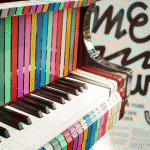
‘Play Me, I’m Yours’ initiative started back in 2008 in Birmingham UK and every year new cities add to this growing international legacy. Street Pianos engage people in musical activies and give the public a possibility to express themselves. Picture Copyright: Gabriele Neeb

gabriele neeb playme

‘Play Me, I’m Yours’ was first commissioned by Fierce Earth in Birmingham, UK in 2008. With 15 pianos located across the city for three weeks it is estimated that over 140,000 people played or listened to music from the pianos. Since then ‘Play Me, I’m Yours’ has reached an estimated six million people worldwide. Each new city that commissions the artwork becomes part of this growing international legacy. Street Pianos are designed to provoke people into engaging, activating and claiming ownership of their urban landscape. Like a musical equivalent of Facebook, Street Pianos, together with this website, provide an interconnected resource for the public to express themselves.

The pianos have also enticed many hidden musicians out of the woodwork. It has become apparent that there are thousands of pianists out there who don’t have regular access to a piano. ‘Play Me, I’m Yours’ provides access to this wonderful musical instrument and gives musicians the opportunity to share their creativity by performing in public.

http://www.isarlust.org/pmiymunich2015/

on the 9th of October there is an opening ceremony for Play me event in Munich. You can follow the news in Facebook under https://www.facebook.com/pmiymunich?fref=ts

Country:

Posted in Piano and tagged , , ,