The melody was created April 2015 after listening to greek orthidix easter-songs …
Country:GreecePosted in Uncategorized and tagged colours, hymn, joy, spring
The melody was created April 2015 after listening to greek orthidix easter-songs …
Country:GreecePosted in Uncategorized and tagged colours, hymn, joy, spring
In the brain, we know that everything connects to everything else, quite literally from front to back and from top to bottom. Only a small number of activities create as many network interconnections as music, from intellectual functions to motor operations. We are not certain which came first, language or music, though it is safe to say both most likely developed with and from each other. Sonic interactions with emotions are familiar to any listener. As a result we have been charting the development of auditory processing that provides keys to assist with dementia,stroke, Alzheimer’s, learning and attention disorders. The study cited below notes some benefits and possibilities.
Examining neural plasticity and cognitive benefit through the unique lens of musical training.
Moreno S1, Bidelman GM2. Hear Res. 2014 Feb;308:84-97. doi: 10.1016/j.heares.2013.09.012.
Abstract. Recent studies indicate that music training provides robust, long-lasting biological benefits to auditory function. Importantly, the behavioral advantages conferred by musical experience extend beyond simple enhancements to perceptual abilities and even impact non-auditory functions necessary for higher-order aspects of cognition (e.g., working memory, intelligence). Collectively, preliminary findings indicate that alternative forms of arts engagement (e.g., visual arts training) may not yield such widespread enhancements, suggesting that music expertise uniquely taps and refines a hierarchy of brain networks subserving a variety of auditory as well as domain-general cognitive mechanisms. We infer that transfer from specific music experience to broad cognitive benefit might be mediated by the degree to which a listener’s musical training tunes lower- (e.g., perceptual) and higher-order executive functions, and the coordination between these processes. Ultimately, understanding the broad impact of music on the brain will not only provide a more holistic picture of auditory processing and plasticity, but may help inform and tailor remediation and training programs designed to improve perceptual and cognitive benefits in human listeners. PMID: 24079993 [PubMed
Country:USAPosted in Uncategorized and tagged cognition, music, neural plasticity
Yesterday i had a pleasure of experiencing a music soiree in Steinway Hause, Munich. It was a kick off event for a whole series of “Musikalisch-Gesellschaftliche Soiree” – the revival of the salon culture. The tradition of salon comes from France. Salon atmosphere is an integral part of the Salon and the choice of location Steinway Hause Munich with Rubinstein Saal makes the salon experience even more real.
The formal structure of the Salon yesterday was the mixture of musical compositions in different styles ranging from French Baroque up to Broadway Music. The special guest was former Professor of Munich High School of Music, Michael Leslie who is famous for his individual and very differentiated Beethoven Interpretations. 20th of March was also the 100th birthday of famous piano legend Svjatoslav Richter and the Leslie’s play of Beethoven was a tribute to Russian pianist. The witty and charming conferencier guides the audience through the program and broke the frontiers between the formal division of performing musicians and listeners. The atmosphere was friendly and open and after the musical part there was time for drinks and interesting conversations in foyer.
Why does the dream of Salon continue to live? The spirit and wit, lively conversations, possibility to meet amazing artists and talk to them, music experience, intellectual touch, interesting discussions and the atmosphere of open dialogue are still important to today’s society and the salon events like “Anna Sutyagina’s musikalisch-literarische Salons” make us hope that the traditions of salons will still continue…
Country:GermanyPosted in Uncategorized and tagged Anna sutyagina, Jennifer Jacob, Michael Leslie, Munich Salon
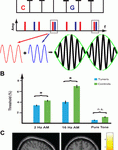
Over a typical career piano tuners spend tens of thousands of hours exploring a specialized acoustic environment. Tuning requires accurate perception and adjustment of beats in two-note chords that serve as a navigational device to move between points in previously learned acoustic scenes. It is a two-stage process that depends on the following: first, selective listening to beats within frequency windows, and, second, the subsequent use of those beats to navigate through a complex soundscape. The neuroanatomical substrates underlying brain specialization for such fundamental organization of sound scenes are unknown. Here, we demonstrate that professional piano tuners are significantly better than controls matched for age and musical ability on a psychophysical task simulating active listening to beats within frequency windows that is based on amplitude modulation rate discrimination. Tuners show a categorical increase in gray matter volume in the right frontal operculum and right superior temporal lobe. Tuners also show a striking enhancement of gray matter volume in the anterior hippocampus, parahippocampal gyrus, and superior temporal gyrus, and an increase in white matter volume in the posterior hippocampus as a function of years of tuning experience. The relationship with gray matter volume is sensitive to years of tuning experience and starting age but not actual age or level of musicality. Our findings support a role for a core set of regions in the hippocampus and superior temporal cortex in skilled exploration of complex sound scenes in which precise sound “templates” are encoded and consolidated into memory over time in an experience-dependent manner.
We assessed brain specialization in a previously unstudied group of expert listeners who spend large amounts of time exploring a complex acoustic environment that requires accurate perception and adjustment. The subjects, piano tuners, perform an active listening and adjustment task every time a piano is tuned where they explore an acoustic scene according to a specific route. Piano tuning is a highly sophisticated skill: a single tuning session might take up to 2 h and a professional tuner may typically tune up to 20 pianos a week, so the highest levels of expertise follow thousands of hours of experience over a period of 20 to 30 years (Capleton, 2007). Thus, this group provides a unique opportunity to investigate neuroanatomical bases of skilled organization of sound scenes.
Piano tuning requires the practitioner to perform successive navigation between tuned and untuned notes in which the beat rate between notes is used as a form of “signpost.” Traditionally, tuning starts with tuning a single note to a standard tuning fork. A two-note chord is then played, comprising the tuned note and another note. The two notes contain multiple frequencies at the fundamental and higher harmonics, and certain harmonics in the two notes occur close to each other and produce beats fluctuations in the envelope of the combined harmonics at a rate equal to their frequency difference (Fig. 1A). The piano tuner is required to detect a particular beat rate corresponding to the interval between the two notes played, and match that to a specific value. A further interval is then tuned based on the most recently tuned note and another note, and this process is repeated iteratively (Fig. 2A). The beat rate and the frequency region in which the beat is to be detected vary for different intervals but are fixed for any given interval with beat rates that are typically less than 20 Hz (Table 1).
Country:ItalyPosted in Uncategorized and tagged http://www.ncbi.nlm.nih.gov/pubmed/22933806
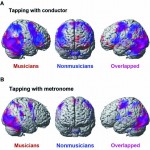
Research has shown that learning to play a musical instrument has dramatic effects on cognition (Schlaug et al., 2005), even after only a few years of training. The beneficial effects of musical training are not limited to enhancement of musical skills [such as, note coding and staff reading (e.g., Proverbio et al., 2013; Wong et al., 2014)] but extend to many other skills, including finger tapping (Braun Janzen et al., 2014), visual memory (Rodrigues et al., 2014), auditory memory (Cohen et al., 2011), speech in noise perception (Strait and Kraus, 2011), auditory temporal processing (Bishop-Liebler et al., 2014), dexterity of finger movements (Furuya et al., 2014), reading skills (Tierney and Kraus, 2013), gesture imitation (Spilka et al., 2010), and non-verbal reasoning (Forgeard et al., 2008). By increasing the number of years of constant practice (musical expertise), the musical ability is thought to improve monotonically, independent of individual musical talent (which naturally affects achievement). Indeed, according to Ericsson et al. (1993), “many characteristics once believed to reflect innate talent are actually the result of intense musical practice extended for a minimum of 10 years.” Interestingly, Groussard et al. (2014) conducted a regression study on 44 non-musicians and amateur musicians with 0–26 years of musical practice with a variety instruments to identify which brain areas undergo gray matter changes as a function of expertise. They found that some brain areas underwent volume changes after only a few years of musical practice, whereas others (especially auditory and motor areas such as the superior temporal and supplementary motor areas) required longer practice before they exhibited changes, thus suggesting a long-lasting learning process.
Front. Psychol., 02 April 2015
http://journal.frontiersin.org/article/10.3389/fpsyg.2015.00376/full
Country:ItalyPosted in Uncategorized and tagged http://journal.frontiersin.org/article/10.3389/fpsyg.2015.00376/full
Research has shown that learning to play a musical instrument has dramatic effects on cognition (Schlaug et al., 2005), even after only a few years of training. The beneficial effects of musical training are not limited to enhancement of musical skills [such as, note coding and staff reading (e.g., Proverbio et al., 2013; Wong et al., 2014)] but extend to many other skills, including finger tapping (Braun Janzen et al., 2014), visual memory (Rodrigues et al., 2014), auditory memory (Cohen et al., 2011), speech in noise perception (Strait and Kraus, 2011), auditory temporal processing (Bishop-Liebler et al., 2014), dexterity of finger movements (Furuya et al., 2014), reading skills (Tierney and Kraus, 2013), gesture imitation (Spilka et al., 2010), and non-verbal reasoning (Forgeard et al., 2008). By increasing the number of years of constant practice (musical expertise), the musical ability is thought to improve monotonically, independent of individual musical talent (which naturally affects achievement). Indeed, according to Ericsson et al. (1993), “many characteristics once believed to reflect innate talent are actually the result of intense musical practice extended for a minimum of 10 years.” Interestingly, Groussard et al. (2014) conducted a regression study on 44 non-musicians and amateur musicians with 0–26 years of musical practice with a variety instruments to identify which brain areas undergo gray matter changes as a function of expertise. They found that some brain areas underwent volume changes after only a few years of musical practice, whereas others (especially auditory and motor areas such as the superior temporal and supplementary motor areas) required longer practice before they exhibited changes, thus suggesting a long-lasting learning process.
Front. Psychol., 02 April 2015 |
Posted in Uncategorized and tagged http://journal.frontiersin.org/article/10.3389/fpsyg.2015.00376/full
A composition using the sounds of nesting bumblebees.
Tibetan singing bowl and percussion made from recycled objects. I am particularly pleased with the way the harmonics of the chimes (made from aluminium sailing masts) and singing bowl work with the bees hum. Headphones or speakers with good bass are required for the low tones of the gong(made from steel juice barrel lid.)
Posted in Uncategorized and tagged natural sounds., percussion, Sound Art
Early experience lays the foundations for the developing musical
mind. Hearing emerges prior to birth (Sansavini, 1997) and
the acoustic environment in utero begins to shape the auditory
system much earlier than sensory systems that are not exposed
to input until after birth, such as vision. Twenty-five week
old fetuses are equipped with structural components of the
ear that allow them to hear (Cheour-Luhtanen et al., 1996).
Hydrophone recordings reveal that many sounds are measurable
in the intrauterine environment, such as the maternal heartbeat,
breathing, digestion, and the maternal voice (Dunham, 1990).
Even non-maternal speech and song is potentially audible, at or
above 60 dB sound pressure level (SPL) and attenuated above
250–500 Hz (Busnel et al., 1992; Gerhardt and Abrams, 1996).
Fetal heart rate evidence suggests that during the third trimester
fetuses discriminate the speech of their mother from that of
a stranger, speech of their native language from a non-native
language (Kisilevsky et al., 2003; Kisilevsky and Hains, 2009),
and they respond differentially to music and speech (Kisilevsky
et al., 2004; Granier-Deferre et al., 2011). Thus, a wide range of
maternal and non-maternal sounds are available and potentially
audible to the fetus during late pregnancy.
The effects of prenatal auditory experience can be observed
among newborns within only a few hours or days after birth. Soon
after birth, infants show a strong preference for their mother’s
voice over the voice of another female (DeCasper and Fifer, 1980;
Cooper and Aslin, 1989; Kisilevsky et al., 2003), their mother’s
language over a foreign language (Moon et al., 1993, 2012), and
specific passages of speech (DeCasper and Spence, 1986) or music
(Hepper, 1991) presented during the final weeks of pregnancy.
Thus, even prior to birth human listeners may begin to acquire
rudimentary auditory representations that may be considered
as the earliest building blocks of the musical mind. Here, we
examine the nature of the prenatal auditory input and its effects
on auditory preferences, perceptual capacities, and musical skills
Posted in Uncategorized and tagged http://journal.frontiersin.org/article/10.3389/fnsys.2013.00048/full
There is considerable evidence that cortical representation of the body may be continuously changed in response to activity, behavior, and skill acquisition (Buonomano and Merzenich 1998). Adaptive changes in neural circuitries related to motor skill-training have also been attributed to improved performance (Nielsen and Cohen 2008). For investigating the latter professional musicians are ideally suited because they begin with training in childhood and practice extensively throughout their life to achieve the most astonishing levels of motor skill perfection. This combination of training specificity (i.e., highly specific motor skills), training intensity, and early training onset has shown to result in considerable use-dependent neural plasticity in professional musicians (Munte et al. 2002).
In string and keyboard players, exceptional skill has been associated with reduced premotor activation and a shift toward more focused (or task relevant) activation in regions related to motor execution—namely, in the primary sensorimotor cortex (Lotze et al. 2003; Haslinger et al. 2004), although decreased involvement of some brain areas has also been reported as a result of more efficient functioning (Jancke et al. 2000). Adaptations on the level of functional or morphologic characterization appear not only as increased cortical representation of hand and fingers (Elbert et al. 1995) but involve also the auditory cortex (Schneider et al. 2002). Corresponding to Hebbian learning (Hebb 1949), cross-modal plasticity has been reported as a consequence of simultaneous integration of auditory and somatosensory signals (Pantev et al. 2003). Other experience-dependent effects in the musicians’ brain involve an increased motor cortical excitability (Rosenkranz et al. 2007), a larger cerebellum (Hutchinson et al. 2003) and anterior corpus callosum (Schlaug et al. 1995) and even a more structured fiber tract organization in white matter (Bengtsson et al. 2005).
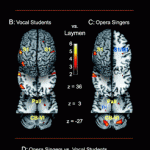
Several studies have shown that motor-skill training over extended time periods results in reorganization of neural networks and changes in brain morphology. Yet, little is known about training-induced adaptive changes in the vocal system, which is largely subserved by intrinsic reflex mechanisms. We investigated highly accomplished opera singers, conservatory level vocal students, and laymen during overt singing of an Italian aria in a neuroimaging experiment. We provide the first evidence that the training of vocal skills is accompanied by increased functional activation of bilateral primary somatosensory cortex representing articulators and larynx. Opera singers showed additional activation in right primary sensorimotor cortex. Further training-related activation comprised the inferior parietal lobe and bilateral dorsolateral prefrontal cortex. At the subcortical level, expert singers showed increased activation in the basal ganglia, the thalamus, and the cerebellum. A regression analysis of functional activation with accumulated singing practice confirmed that vocal skills training correlates with increased activity of a cortical network for enhanced kinesthetic motor control and sensorimotor guidance together with increased involvement of implicit motor memory areas at the subcortical and cerebellar level. Our findings may have ramifications for both voice rehabilitation and deliberate practice of other implicit motor skills that require interoception.
Country:ItalyPosted in Uncategorized and tagged http://www.ncbi.nlm.nih.gov/pubmed/19692631
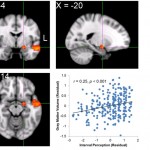
Music is not simply a series of organized pitches, rhythms, and timbres, it is capable of evoking emotions. In the present study, voxel-based morphometry (VBM) was employed to explore the neural basis that may link music to emotion. To do this, we identified the neuroanatomical correlates of the ability to extract pitch interval size in a music segment (i.e., interval perception) in a large population of healthy young adults (N = 264). Behaviorally, we found that interval perception was correlated with daily emotional experiences, indicating the intrinsic link between music and emotion. Neurally, and as expected, we found that interval perception was positively correlated with the gray matter volume (GMV) of the bilateral temporal cortex. More important, a larger GMV of the bilateral amygdala was associated with better interval perception, suggesting that the amygdala, which is the neural substrate of emotional processing, is also involved in music processing. In sum, our study provides one of first neuroanatomical evidence on the association between the amygdala and music, which contributes to our understanding of exactly how music evokes emotional responses.
“Without music, life would be a mistake.”
Friedrich Nietzsche, Twilight of the Idols
Music is a powerful tool for evoking emotional responses. Tears burst out uncontrolledly when “The Queen’s Epicedium” (Henry Purcell and John Blow, 1695) is performed, whereas intense joy floods our heart when we hear “The Blue Danube” (Johann Strauss II, 1866). Indeed, behavioral studies have shown that music evokes various emotions, and can help patients feel less anxious and reduce postoperative pain. However, little is known about the neural basis that links music and emotion. In the present study, we addressed this question by exploring the neuroanatomical correlates of individuals’ behavioral performance in music processing.
The amygdala, a core component in the neural circuits of emotional processing and emotional experiences, has attracted attention for its significance in processing music. Previous functional neuroimaging studies have demonstrated the amygdala’s involvement in music processing. First, exposure to music scoring high on emotional valence (e.g., pleasant and unpleasant music) activates the amygdala. Specifically, this region of the brain is activated when participants experience a positive emotion after being exposed to pleasant music or when they experience a negative emotion after listening to unpleasant music. Second, in addition to responding to pleasant or unpleasant music, the amygdala may respond to the occurrence of fairly abstract musical features, such as unexpected chords (the processing of which is perceived as being less pleasant than the processing of expected chords).
In contrast, structural magnetic resonance imaging (MRI) studies relying on the measurement of cortical thickness and/or voxel-based morphometry have only focused on frontotemporal circuits as neuroanatomical correlates of music processing. While the role of the amygdala in music processing is largely ignored in structural MRI studies, there is abundant evidence showing that the anatomical structure of the amygdala is correlated with emotional processing. For example, amygdala gray matter volume (GMV) or density is correlated with magnitude of stress and anxiety in the normal population, and the change of amygdala volume is a neural signature of a variety of emotion-related disorders, such as major depressive disorder, bipolar disorder, borderline personality disorder, posttraumatic stress disorder, and autism. Finally, lesions of the amygdala severely impair emotional processing, such as emotion recognition, emotion arousal, and emotion judgment.
Country:ItalyPosted in Uncategorized and tagged http://journals.plos.org/plosone/article?id=10.1371/journal.pone.0099889